 Wiessel un Inhalt

Every office manager and procurement director eventually faces the classic floor plan conundrum: should you standardise your facility on a high-capacity 4-drawer filing cabinet or deploy flexible 2-drawer units directly alongside staff workstations? At first glance, the arithmetic appears deceptively simple—one 4-drawer model stores twice as much paper as a 2-drawer unit. However, on active corporate floor plates, commercial records storage is governed by floor loading limits, daily retrieval ergonomics, departmental acoustic zoning, and critical workplace safety mechanisms.
Whether you are outfitting a regional legal headquarters, upgrading administrative rooms in a municipal hospital, or consolidating bulk shipping containers from an established Chinese manufacturer, choosing between a 4-drawer filing cabinet and a 2-drawer configuration dictates both your capital expenditure and how efficiently your teams operate every morning. If you are concurrently planning perimeter personal storage or locker banks, you can cross-reference our engineering evaluations on Archivschränke aus Stol a kommerziell Bürosschléisser to build a fully coordinated workplace layout.
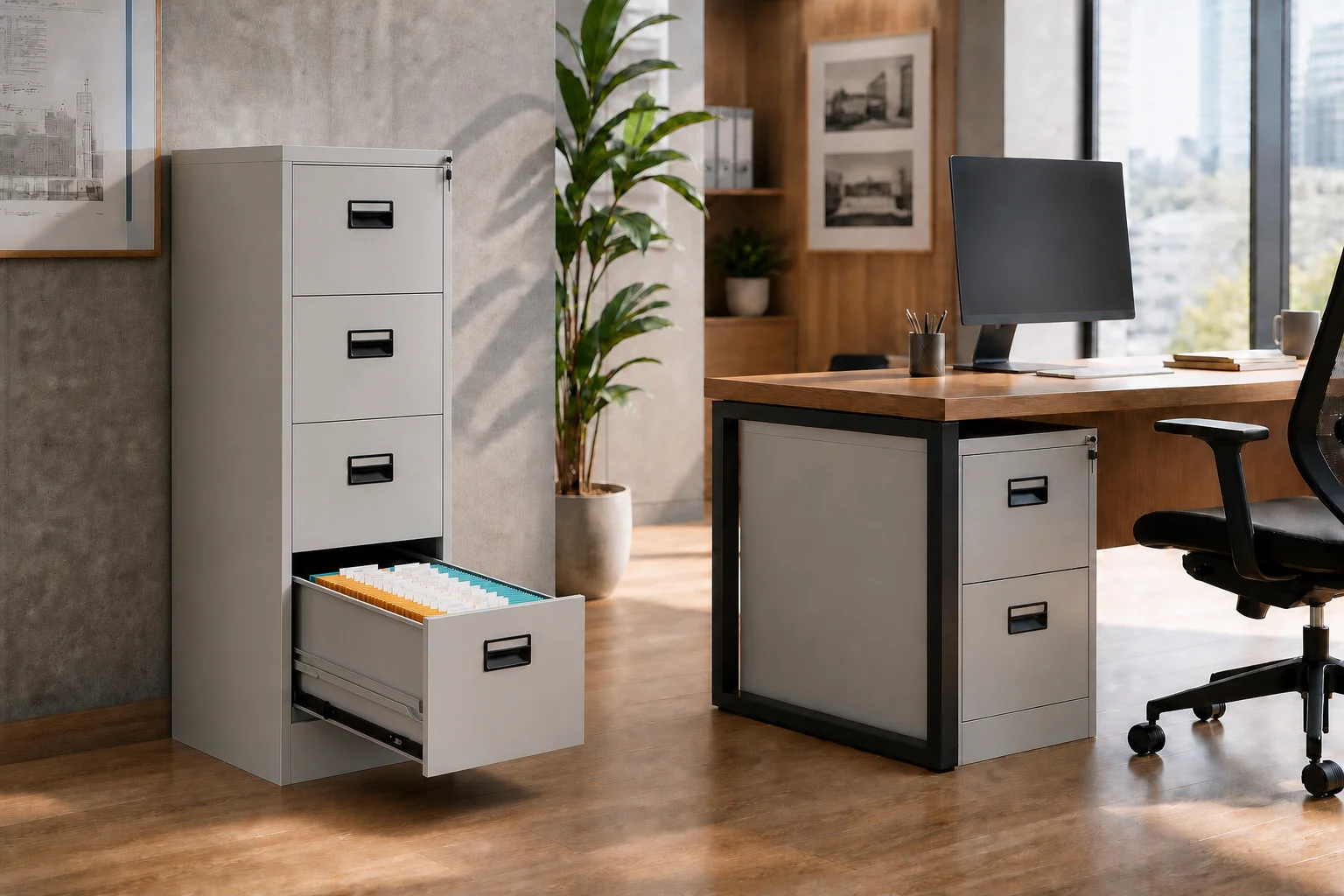
The Fundamental Spatial Difference: Vertical Density vs. Workstation Integration
The primary divider between these two institutional workhorses comes down to vertical spatial efficiency. A commercial vertical 4-drawer filing cabinet stands approximately 1,320 mm to 1,335 mm tall (roughly 52 to 52.5 inches), maintaining a standard width of 460 mm (18 inches) and an export depth of 620 mm (24.4 inches). This design harnesses empty vertical ceiling space, occupying just 0.285 square metres (3.07 sq ft) of floor area while delivering four separate full-extension suspension tiers.
In contrast, a 2-drawer filing cabinet stands between 710 mm and 730 mm tall (28 to 28.7 inches), matching the standard height of modern modular system desks. This dimension is engineered deliberately so facility teams can roll or slide the cabinet directly beneath worksurfaces, reclaiming otherwise wasted knee-well space. Alternatively, placed directly beside a desk, a 2-drawer unit serves as an immediate side return, creating an extended horizontal staging area for printers, desktop scanners, or incoming project binders without dividing the visual landscape of an open-plan office.
When calculating commercial real estate overhead—especially in metropolitan commercial hubs where square-metre leasing costs demand maximum density—deploying 4-drawer filing cabinets along structural perimeter walls frees up substantial square footage for collaborative pods and circulation corridors.
Storage Capacity by the Numbers: How Many Files Can You Actually Pack?
When estimating file storage volumes, procurement specs should never rely on vague terms like “large capacity” or “heavy file storage.” In institutional archives, file density is measured in usable linear inches (or millimetres) of suspension rod length and gross weight capacity.
Commercial drawers manufactured from cold-rolled SPCC steel typically provide 510 mm to 535 mm (20 to 21 inches) of usable front-to-back hanging rail depth per tier. Let us examine the actual storage throughput:
- 4-Drawer Filing Cabinet Capacity: Offers approximately 2040 mm to 2140 mm (80 to 84 linear inches) of total suspension capacity in single-row legal/letter orientation. For standard 80 gsm document paper packed in heavyweight Manila suspension folders, this equates to roughly 10,000 to 12,000 sheets of documentation. Rated for 40 kg to 45 kg (88 to 100 lbs) dynamic payload per drawer on heavy-duty ball-bearing slides, a quality 4-drawer filing cabinet safely supports up to 180 kg (nearly 400 lbs) of solid commercial records.
- 2-Drawer Filing Cabinet Capacity: Delivers approximately 1020 mm to 1070 mm (40 to 42 linear inches) of linear filing space, accommodating 5,000 to 6,000 sheets with a cumulative payload rating of 80 kg to 90 kg.
For paper-intensive operations such as law firms, accounting practices, civil court registries, and medical records departments, four 2-drawer cabinets would consume over 1.14 m² of prime floor space to match the filing volume that a single 4-drawer filing cabinet accommodates on just 0.285 m².
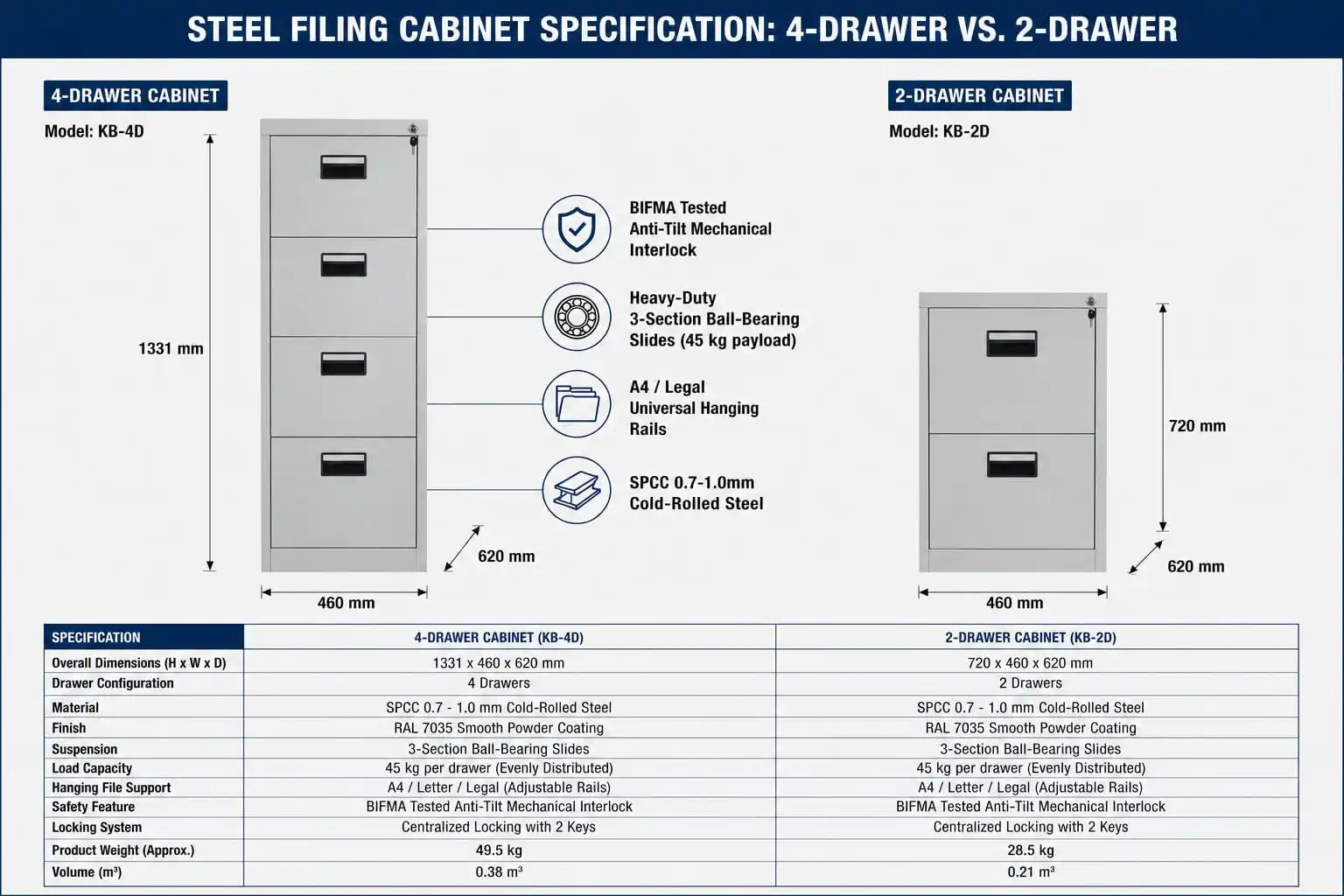
Specification Comparison: 4-Drawer vs. 2-Drawer Steel Filing Cabinets
To assist architects, interior space planners, and commercial tender officers in preparing bidding schedules, the table below compares core engineering benchmarks across both configurations:
| Engineering Benchmark | Commercial 4-Drawer Filing Cabinet | Commercial 2-Drawer Filing Cabinet |
|---|---|---|
| Standard Outer Dimensions | H1331 × W460 × D620 mm (52.4″ × 18.1″ × 24.4″) | H720 × W460 × D620 mm (28.3″ × 18.1″ × 24.4″) |
| Usable Linear File Space | 2,080 mm (82 inches) total | 1,040 mm (41 inches) total |
| Sheet Capacity (Standard Paper) | 10,000-12,000 Blieder | 5,000-6,000 Blieder |
| Dynamic Load Per Drawer | 40 – 45 kg (88 – 100 lbs) / drawer | 40 – 45 kg (88 – 100 lbs) / drawer |
| Anti-Tilt Safety Mechanism | Mandatory mechanical interlock (1 drawer at a time) | Counterweight bar or front anti-tip caster (mobile models) |
| Drawer Slide Architecture | 3-section telescopic full-extension steel ball-bearing | 3-section telescopic full-extension steel ball-bearing |
| Filing Format Compatibility | A4, US Letter, US Legal, Foolscap (via adjustable crossbars) | A4, US Letter, US Legal, Foolscap (via adjustable crossbars) |
| Raw Steel Thickness (SPCC) | 0.6 – 1.0 mm cold-rolled steel body & cradle | 0.6 – 1.0 mm cold-rolled steel body & cradle |
| Export KD Carton Volume (CBM) | Approx. 0.085 – 0.098 CBM (flat-pack) | Approx. 0.052 – 0.062 CBM (flat-pack) |
The Anti-Tilt Safety Factor: Why 4-Drawer Units Demand Mechanical Interlocks
Safety is the single most critical engineering specification when ordering a tall 4-drawer filing cabinet. A fully laden 4-drawer cabinet holds upwards of 160 kg to 180 kg of paperwork. When a user extends two or three drawers simultaneously, the centre of gravity shifts violently forward beyond the footprint of the base. Without built-in safety controls, this triggers catastrophic forward tipping that can cause severe workplace injuries or crush incidents.
Reputable contract steel manufacturers incorporate an automated mechanical drawer interlock mechanism (often called an anti-tilt linkage bar). This internal linkage rod, running vertically behind the drawer cradles, physically locks the remaining three drawers the moment any single drawer is opened by more than 20 mm. Under international institutional safety codes (such as ANSI/BIFMA X5.2 in North America and BS EN 14073 in the UK/EU), testing laboratories subject 4-drawer vertical units to aggressive static pull forces and operational cycle testing to verify that simultaneous multi-drawer extension is impossible.
For 2-drawer units, the risk profile is substantially different. Standing only 720 mm high, a 2-drawer cabinet possesses a low centre of gravity. In stationary vertical pedestals, an internal counterweight steel plate or concrete block (typically 12 kg to 18 kg) fitted into the rear base panel provides sufficient ballast. On mobile 2-drawer units equipped with wheels, manufacturers fit an auxiliary fifth caster beneath the bottom drawer face to counteract forward tip loads when the bottom file drawer is pulled fully open.
When drafting your tender technical schedule, always specify: “Vertical 4-drawer filing cabinet units must feature a factory-tested internal mechanical anti-tilt interlock system preventing simultaneous extension of multiple drawers.” For deeper insight into how structural steel fabrication impacts institutional safety compliance, consult our guide on Stahlschränke vs. Metallschränke.
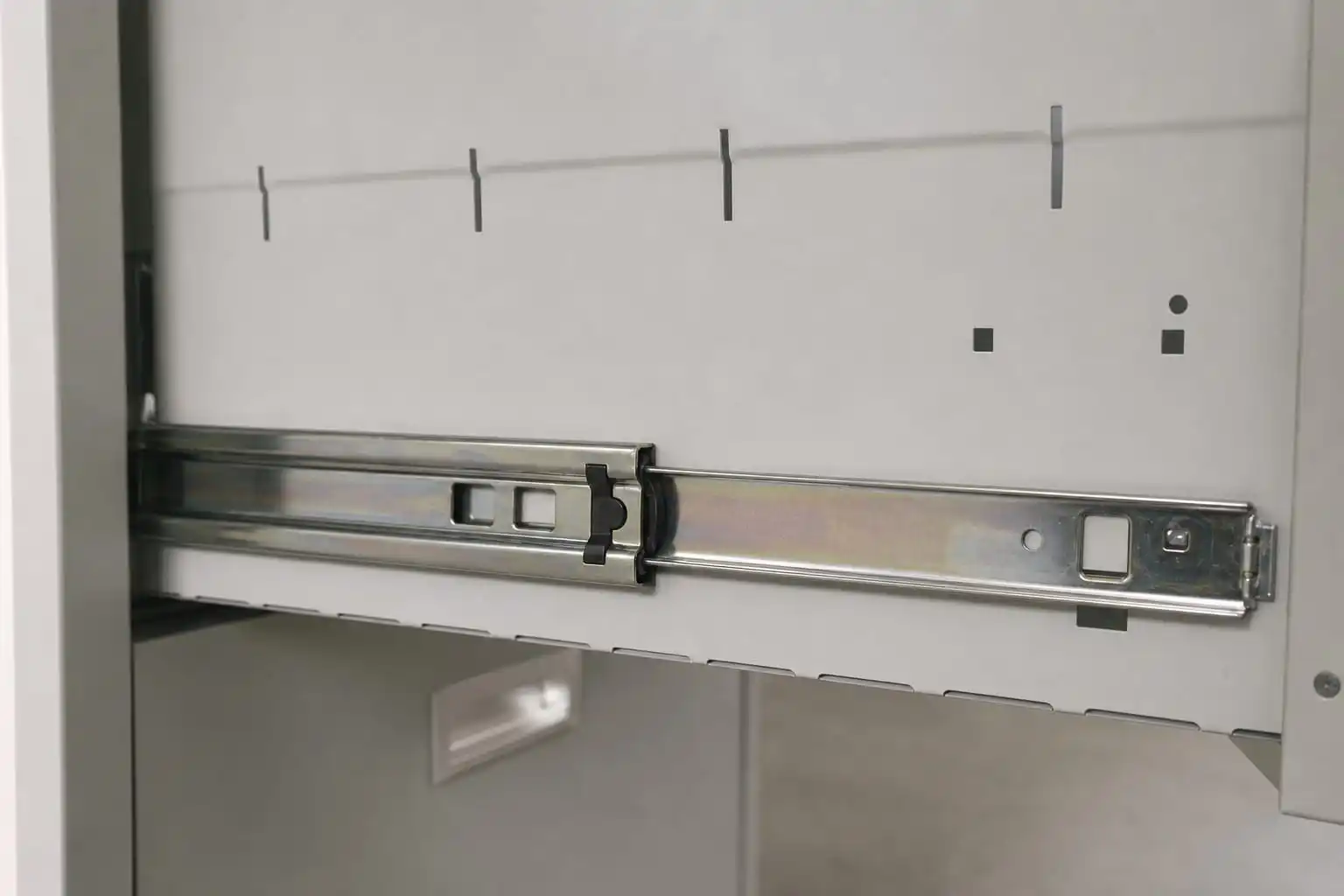
Drawer Slide Mechanics: Ball-Bearing Slides vs. Friction Rollers
Regardless of whether you select a 2-drawer or 4-drawer cabinet, the operational lifespan of the piece is dictated by the drawer suspension hardware. In low-budget domestic retail cabinets, manufacturers frequently cut costs by installing rudimentary plastic wheels riding inside folded sheet metal channels. Under a 35 kg commercial paper load, these nylon rollers warp within 6 to 12 months, resulting in misaligned drawer faces, jammed locks, and excessive operational noise.
Institutional procurement demands 3-section full-extension telescopic ball-bearing slides stamped from 1.2 mm to 1.5 mm cold-rolled carbon steel, housing double or triple rows of solid steel ball bearings lubricated with high-grade synthetic grease. Key performance benchmarks include:
- 100% Full Extension: The slide must extend beyond the front face of the cabinet body by 100% of the drawer depth. This ensures staff can drop files directly into the rearmost hanging folder without scraping their knuckles against the cabinet header.
- BIFMA 50,000-Cycle Endurance: Commercial-grade slides must endure 50,000 continuous opening and closing cycles under full rated payload (45 kg) without bearing ejection or track deformation.
- Integrated Cushion Buffers: Rubber dampener bumpers mounted at the slide stops prevent metallic rattling and slamming during rapid office retrieval.
When inspecting pre-shipment golden samples, test the drawer travel when loaded to capacity. A quality 4-drawer filing cabinet should glide smoothly with an initial pull force of less than 25 Newtons (approximately 2.5 kg of effort).
Locking Systems and Document Security in Shared Offices
Modern regulatory environments—including GDPR in Europe and HIPAA in the United States—mandate strict physical security for physical personnel files, financial statements, and patient records. In commercial steel furniture, security relies on an integrated central gang-locking system.
In a 4-drawer filing cabinet, turning a single key in the top-right lock core drives an internal vertical steel cam rod downward, engaging locking tabs into all four drawer cradles simultaneously. High-security institutional cabinets incorporate interchangeable core cylinder locks (removable core barrels), allowing facilities teams to re-key entire corporate floors in minutes using a master control key without disassembling the cabinet framework.
For shared workstations where multiple staff members share a 2-drawer mobile pedestal, buyers can specify individual drawer keying or multi-user mechanical combination dials, eliminating the administrative headache of lost physical keys. When consolidating office storage packages with personal staff changing areas, review our procurement guide for kommerziell Späicher to align lock master-key hierarchies across all storage assets.
Knock-Down (KD) Flat-Pack vs. Pre-Assembled Freight Economics
For overseas distributors, municipal contractors, and office furniture importers, shipping volume (CBM) frequently represents 25% to 40% of the total landed cost. Shipping pre-welded, fully assembled 4-drawer filing cabinets from China is an economic disaster: a 40-foot High Cube (40’HQ) container holds barely 120 to 140 assembled 4-drawer units because you are essentially paying ocean freight to transport empty air inside the drawer cavities.
Industrial steel manufacturers in Luoyang solve this through precision Knock-Down (KD) flat-pack engineering:
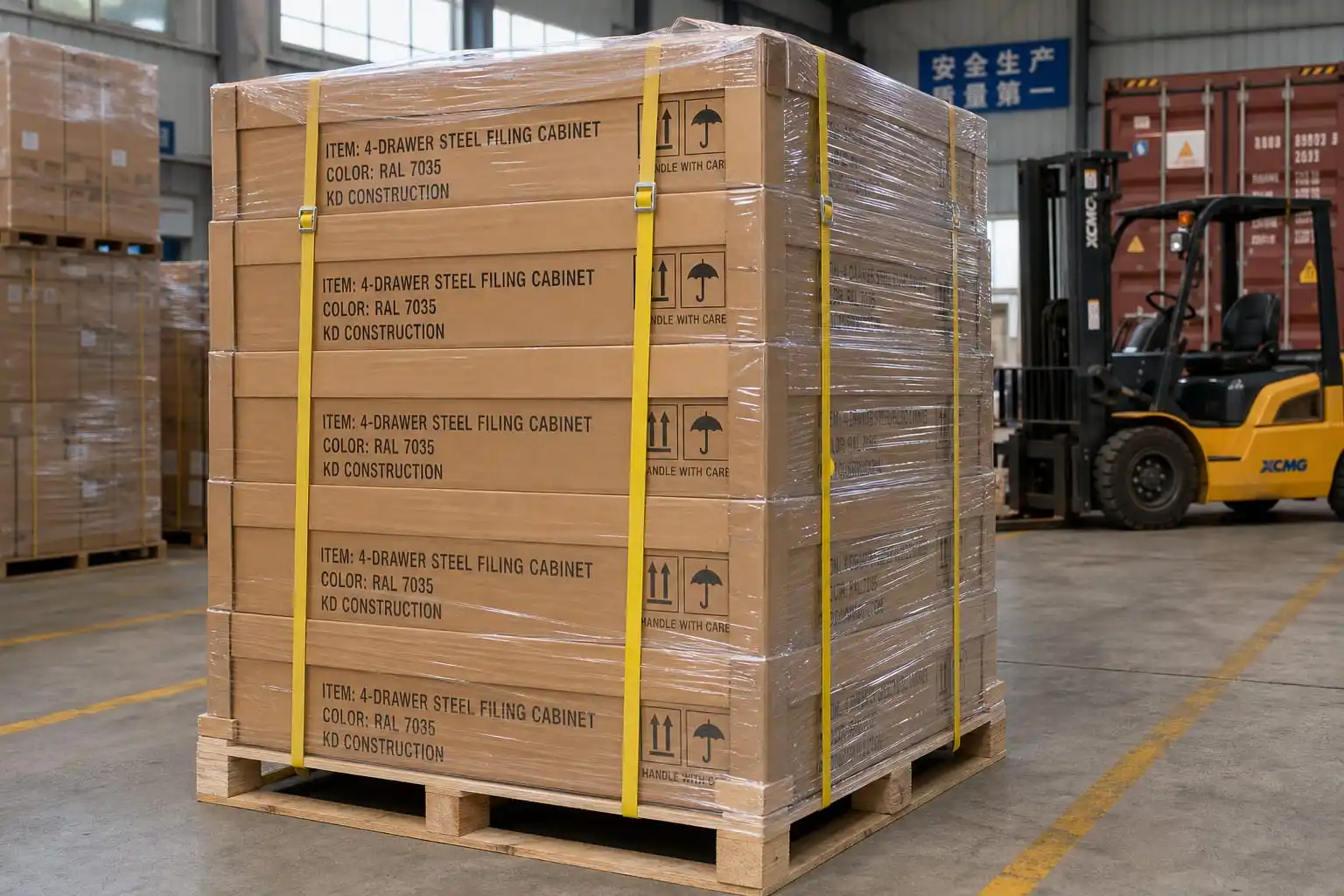
- Volume Reduction of 75%: A KD 4-drawer filing cabinet disassembles into flat side panels, backplate, bottom frame, header, and four flat-packed drawer envelopes. Packed into a multi-layer corrugated export carton with high-density EPE foam corner blocks, the total packaged volume drops to just 0.088 to 0.095 CBM.
- Massive Container Capacity: A single 40’HQ container comfortably accommodates 550 bis 620 Eenheeten of KD 4-drawer filing cabinets, or up to 950 Unitéiten of 2-drawer KD pedestals. This slashes ocean freight costs per unit by nearly 70%.
- Rapid Assembly Protocols: Modern KD filing cabinets utilize snap-in slot-and-wedge joints and precision-located machine screws. A trained two-person facility team can assemble a 4-drawer filing cabinet in 12 to 15 minutes using a single cordless electric screwdriver.
For government and institutional buyers managing multi-building installations, combining KD filing cabinets with Miwwelen fir Studentenheem oder méistufeg Fitnessstudio-Späicher in consolidated containers ensures maximum container fill rates and minimum landed cost per cubic metre. To explore full factory logistics, review our deep dive on wholesale lockers from China.
Procurement Decision Matrix: Which Should You Order?
To finalize your purchasing requisition or commercial tender schedule, apply this straightforward operational checklist:
Order the 4-Drawer Filing Cabinet If:
- Your central archive is space-constrained: You need to archive thousands of historical files, financial records, or medical dossiers in a dedicated records room or against perimeter building columns.
- Maximum linear filing per dollar is your primary KPI: A 4-drawer unit delivers the lowest procurement cost per linear filing centimetre compared to purchasing multiple smaller cabinets.
- You require centralized file security: A single key turn secures over 10,000 documents in one central, fire-resistant SPCC steel housing.
Order the 2-Drawer Filing Cabinet If:
- You are furnishing modular open-plan workstations: You need individual file storage tucked neatly beneath standard 750 mm high office desks to maintain clear line-of-sight across the floor plate.
- Staff require immediate, seated document access: Active project files need to be retrieved from an ergonomic seated position without standing up.
- You need mobile workplace agility: Mounted on heavy-duty casters, 2-drawer mobile pedestals can be rapidly redeployed when project teams reorganize or hot-desking zones shift.
Froen an Froe Froen (FAQ)
How much weight can a commercial 4-drawer filing cabinet hold?
A heavy-duty commercial 4-drawer filing cabinet manufactured from 0.7–1.0 mm SPCC cold-rolled steel is engineered to hold 40 kg to 45 kg (88–100 lbs) of dynamic weight per drawer on telescopic ball-bearing slides. The entire cabinet safely supports a cumulative payload of 160 kg to 180 kg (350–400 lbs) when evenly distributed across all four tiers.
Can a 4-drawer filing cabinet hold both Legal and Letter size files?
Yes. Commercial vertical filing cabinets come equipped with adjustable internal steel hanging rails or slotted side channels. These crossbars allow users to configure each drawer independently for standard US Letter (8.5 × 11 inch), US Legal (8.5 × 14 inch), European A4, or Foolscap suspension folders.
Why is an anti-tilt mechanism mandatory on tall steel filing cabinets?
Because a fully loaded 4-drawer filing cabinet contains over 160 kg of paperwork, opening more than one drawer simultaneously shifts the centre of gravity past the cabinet base, posing a catastrophic tipping hazard. An internal mechanical anti-tilt linkage bar ensures that opening any single drawer automatically locks the remaining three drawers in place, fulfilling ANSI/BIFMA X5.2 and EN 14073 workplace safety standards.
What is the minimum order quantity (MOQ) for custom steel filing cabinets?
Our standard factory minimum order quantity (MOQ) for wholesale steel filing cabinets is 100 Unitéiten. Buyers can mix different drawer configurations (e.g. 50 units of 4-drawer cabinets combined with 50 units of 2-drawer mobile pedestals) or consolidate orders with other steel lockers and storage cabinets within a single 20GP or 40HQ container to achieve custom RAL powder coating finishes.
How long does it take to assemble a Knock-Down (KD) filing cabinet?
Using modern slot-in wedge joints and pre-aligned screw locations, an experienced two-person assembly team takes approximately 12 to 15 minutes to assemble a 4-drawer filing cabinet, and under 8 minutes for a 2-drawer cabinet. All KD shipments include pictorial assembly manuals, numbered hardware packs, and QR codes linking to factory step-by-step video tutorials.
Planning an Office Storage Upgrade or Commercial Furniture Tender?
LYBESTEEL manufactures institutional-grade 2-drawer, 3-drawer, and 4-drawer steel filing cabinets with BIFMA-certified anti-tilt safety systems and durable smooth flat powder coating. We provide CAD space planning, customized master-key architectures, and direct factory pricing for wholesale B2B projects worldwide.
Contact our commercial project desk today for technical spec sheets, sample lock sets, and direct 20GP/40HQ volume quotations, or explore our complete Produktkatalog vun der Stahlschrank.


