 Skip to content

Commercial bunk beds for camps wholesale need three things that residential beds don’t: steel frames rated for 400+ lbs per platform, powder-coated finishes that survive disinfectant cleaning cycles, and full ASTM F1427 safety compliance — all at a per-unit cost that makes outfitting 50 cabins feasible.
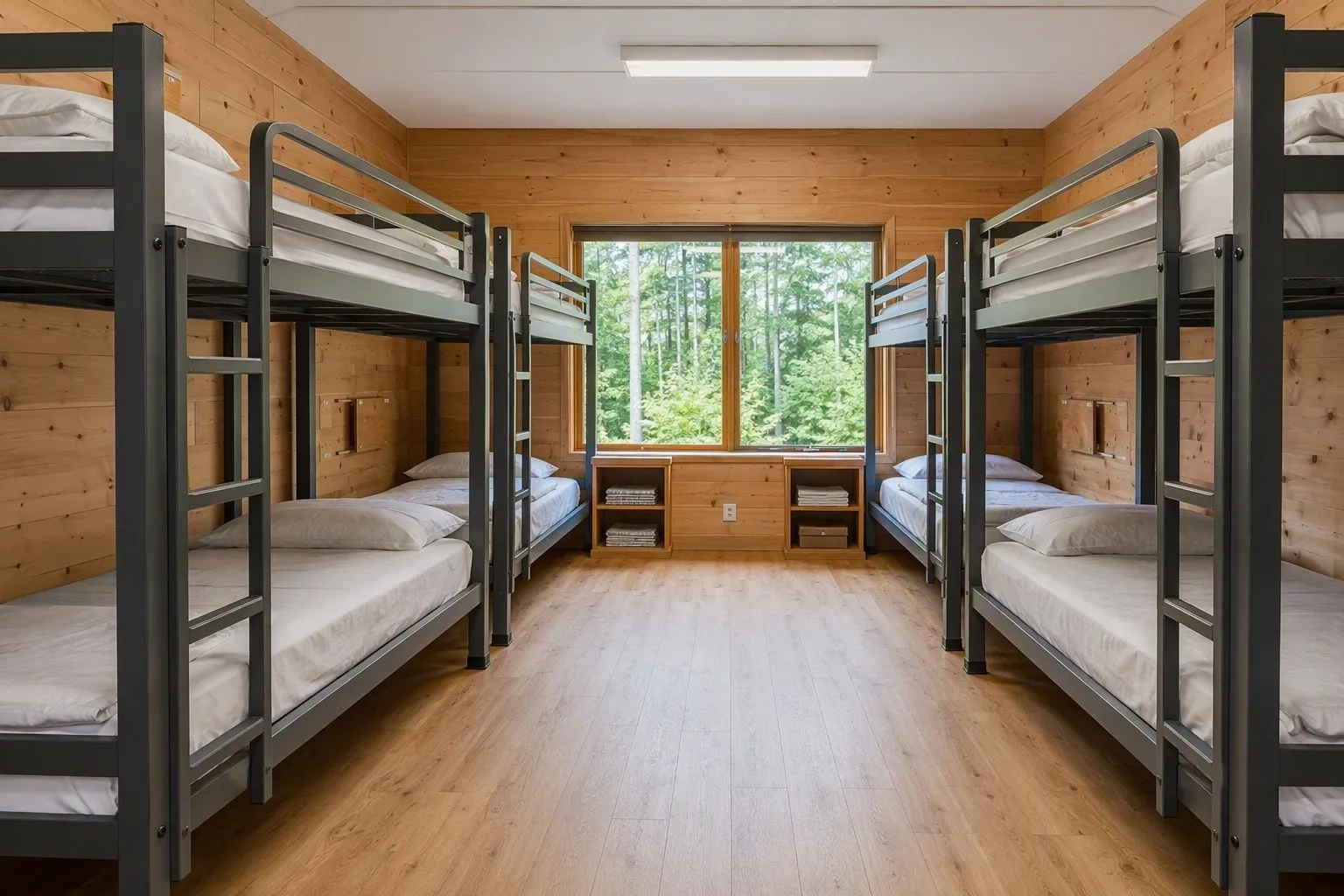
Every summer, about two weeks before camp opens, someone discovers the problem.
A maintenance walk-through reveals a crack in the top bunk’s support rail. A guardrail bolt has stripped out of its hole. The powder coat on last year’s batch is already showing rust spots around the welds because the supplier used a single-stage finish instead of a proper epoxy base.
The camp director calls the original vendor. The vendor says those beds were “residential grade” and aren’t covered for commercial use. The replacement quote is triple what they paid. And now there are 60 campers arriving in 10 days.
This isn’t a hypothetical. I’ve heard versions of it from camp operators, hostel managers, and facility directors across three continents. The root cause is always the same: procurement treated bunk beds as furniture, when they should have been treated as infrastructure.
If you buy beds once every 10–15 years for a facility that sleeps hundreds of people per season, the math changes. Here’s how to get it right.
What Separates Commercial Bunk Beds from the Stuff in a Furniture Store Catalog
Walk into any big-box furniture retailer and you’ll find metal bunk beds for 200–400. They look the part — twin over twin, powder-coated frame, integrated ladder. But put 12-year-olds on them for eight straight weeks and the difference becomes obvious fast.
Commercial bunk beds for camps wholesale are built to a fundamentally different specification. The frame members are thicker — typically 1.5″ to 2″ steel tubing or angle iron, not the 1″ thin-wall tube used in residential beds. Joints are fully welded, not bolted together with barrel nuts that loosen under dynamic load. The powder coat is an epoxy-polyester hybrid applied at 60–80 microns after a phosphate pre-treatment, not a single-stage polyester sprayed over bare metal.
The weight tells half the story. A residential twin-over-twin metal bunk weighs about 80–100 lbs. A commercial-grade equivalent weighs 140–180 lbs. That extra weight is steel where it matters: in the corner posts, the longitudinal support rails, the mattress platform cross-members, and the ladder attachment points.
Steel Gauge, Welds, and the Finish That Survives Disinfectant
Camp environments are rough on furniture. The beds get moved between cabins during off-season reconfiguration. Kids jump on them, hang off the guardrails, and occasionally drag them across concrete floors. Maintenance staff wipe them down with bleach-based cleaners between sessions. In humid climates, condensation forms on cold steel overnight.
Four things determine whether the beds survive year five:
Steel thickness. The frame should be 1.5mm minimum wall thickness for the main structural members (corner posts, side rails). Cross-members and slats can be 1.2mm. Anything thinner and you’ll get frame flex, then weld fatigue, then catastrophic failure — usually where the top bunk support meets the corner post.
Weld quality. Look for continuous MIG welds at all structural joints, not tack welds with cosmetic grinding. Tack-welded joints concentrate stress at the contact points. A continuous weld distributes load through the full joint. Ask the supplier for a close-up photo of the corner post-to-side rail weld on a finished unit. If they won’t send it, that’s information.
Powder coat system. Epoxy-polyester hybrid powder, applied after a zinc phosphate pre-treatment wash, cured at 180–200°C. This combination gives you chemical resistance (for cleaning products), UV resistance (for beds near windows), and impact resistance (for everything else). Ask for the coating spec in microns. Below 50 microns, expect rust within two years in any environment with humidity.
Floor contact points. The best commercial bunk beds have plastic or rubber end caps on the leg bottoms, not bare steel sitting directly on the floor. This isolates the metal from floor moisture, reduces noise when beds are moved, and prevents the slow grind of steel-on-concrete that wears through the powder coat at the contact point.

ASTM F1427 and the Safety Standards That Aren’t Optional
If your camp is in the United States, ASTM F1427 is the governing safety standard for bunk beds. It covers guardrail height and spacing, mattress retention, structural integrity under static and dynamic load, and warning label requirements.
Key requirements that procurement should verify:
- Guardrails on both sides of the top bunk (not just the open side). The wall-side guardrail must be continuous and extend at least 5 inches above the mattress surface.
- Guardrail gap: openings in the guardrail structure must be small enough to prevent head entrapment — no gap larger than 3.5 inches.
- Mattress-to-guardrail height: the top of the guardrail must be at least 5 inches above the top of the mattress when compressed.
- Ceiling clearance: the space between the top of the top bunk mattress and the ceiling must be at least 30 inches to prevent head injury when sitting up.
- Ladder rung spacing: uniform spacing with a minimum tread depth that accommodates a child’s foot (typically 3–4 inch tread depth, rungs no more than 12 inches apart).
- Foundation support: the mattress platform must support a static load of 400+ lbs without permanent deformation (commercial grade; ASTM minimum for consumer is lower).
If you’re buying from an overseas supplier, ask directly: “Does this model comply with ASTM F1427-21e1?” If they say “our beds are very safe” but don’t cite the standard, they haven’t had the design independently verified.
For camps outside the US, the equivalents are EN 747 (Europe), AS/NZS 4220 (Australia/New Zealand), and BS EN 747 (UK). The requirements are similar — the physics of a child falling from a top bunk don’t change by jurisdiction.
Bulk Buying: MOQ, Pricing Reality, and What a Container Actually Holds
This is where the difference between a retail purchase and a wholesale procurement becomes real.
Pricing. Commercial-grade twin-over-twin metal bunk beds from a factory-direct supplier typically range from 80–150perunitEXWforstandardconfigurations,dependingonsteelthickness,finishspec,andordervolume.Add15–30600–1,000 per unit — the markup covers warehousing, single-unit shipping, and retail margin.
MOQ. Factory-direct MOQs typically start at 30–50 units for a container order. Fully custom OEM (custom color, custom guardrail design, branding) usually requires 100+ units. If a supplier offers “MOQ 5 units, any color,” they’re likely a trading company reselling factory stock.
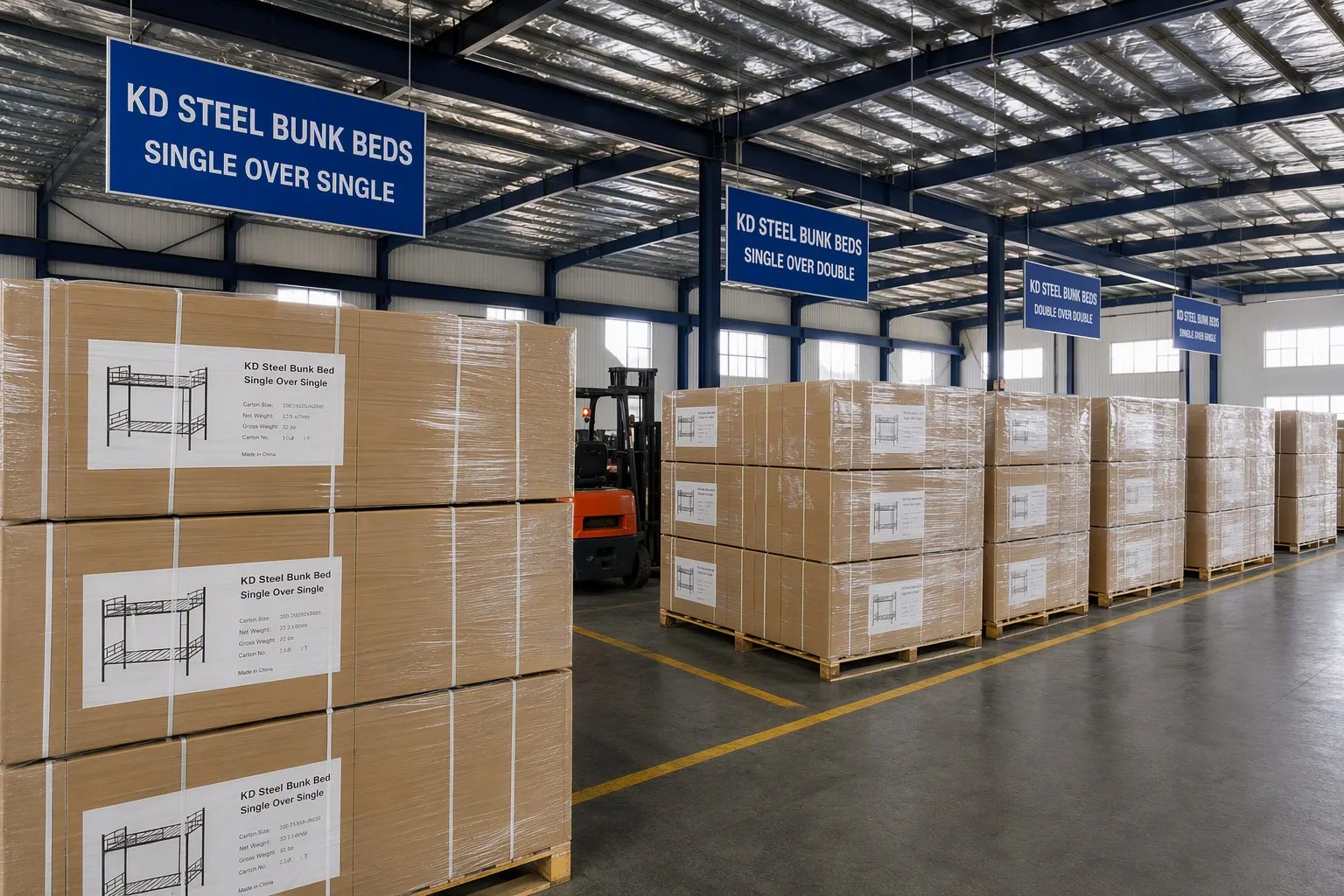
Container math. A 40HQ container can hold approximately 80–120 commercial bunk beds in flat-pack (KD) configuration, depending on bed dimensions and packaging density. That’s enough to outfit 40–60 rooms/cabins at two beds per room. Flat-pack shipping reduces freight cost by roughly 40% compared to fully assembled units, but requires on-site assembly labor — budget 30–45 minutes per bed for a two-person team with basic tools.
Assembly design. The best KD bunk beds use a mortise-and-tenon or slot-together frame design where the side rails drop into machined slots in the corner posts, secured by bolts threaded into welded nuts (not barrel nuts or wood screws into particleboard). A well-designed commercial bunk bed should assemble with one wrench and no power tools.
Configuration Guide: What Works for Which Camp Type
Not every camp needs the same bed layout.
Twin-over-twin is the standard for most summer camps and retreat centers. It maximizes sleeping capacity per square foot while keeping the top bunk accessible to children aged 8 and up. For younger campers (under 7), avoid top bunks entirely — go with single beds or floor-level bunks.
Twin-over-full gives camp counselors and staff a wider lower bunk while keeping the top bunk for a camper. This configuration is common in cabins where one adult supervises 2–4 children.
Triple bunks (three stacked platforms) exist but are heavily regulated and banned in some jurisdictions. They require significantly higher ceilings (typically 10+ feet) and additional structural reinforcement. Unless you have a specific space constraint and a signed-off safety review, stick with twin-over-twin.
Detachable vs. welded units. Some commercial bunk beds are designed as two separate single beds that can be stacked into a bunk or used individually. This gives operational flexibility for off-season reconfiguration but adds cost and weight. Fully welded bunk units are simpler, stronger, and cheaper — but they’re bunk beds forever.
Mattress compatibility. Commercial bunk beds typically fit standard twin mattresses (38″ × 75″), but always confirm the platform dimensions with the supplier. Some commercial platforms are 36″ wide to accommodate institutional mattresses, which are slightly narrower than residential twins. Ordering 50 mattresses that don’t fit the 50 beds you just imported is an expensive oversight.
Six Questions to Ask Before You Place a Container Order
- “What’s the per-platform static and dynamic load rating?” — Static should be 400+ lbs for commercial. Dynamic (impact) should be tested with a drop weight per ASTM F1427.
- “Show me the weld at the corner post-to-side rail junction.” — Continuous MIG bead, not tack welds. If they won’t send a photo, that’s your answer.
- “What’s the powder coat spec — pre-treatment, powder type, thickness in microns?” — Zinc phosphate pre-treatment + epoxy-polyester hybrid + 60–80 microns is the target. “We use good paint” is not a spec.
- “Do you have third-party ASTM F1427 compliance testing for this model?” — Not “similar model.” Not “we follow the standard.” This specific model, tested by an accredited lab.
- “What’s the assembly method and estimated time per bed?” — Slot-together frame with bolt-through connections, 30–45 minutes, one tool. If assembly requires three people and a YouTube tutorial, factor that into your labor budget.
- “How are the beds packaged for container shipment?” — Individual poly-bagging, foam edge protectors, corrugated corner guards, palletized and stretch-wrapped. If the answer is “we put them in a box,” expect transit damage.
The Bottom Line
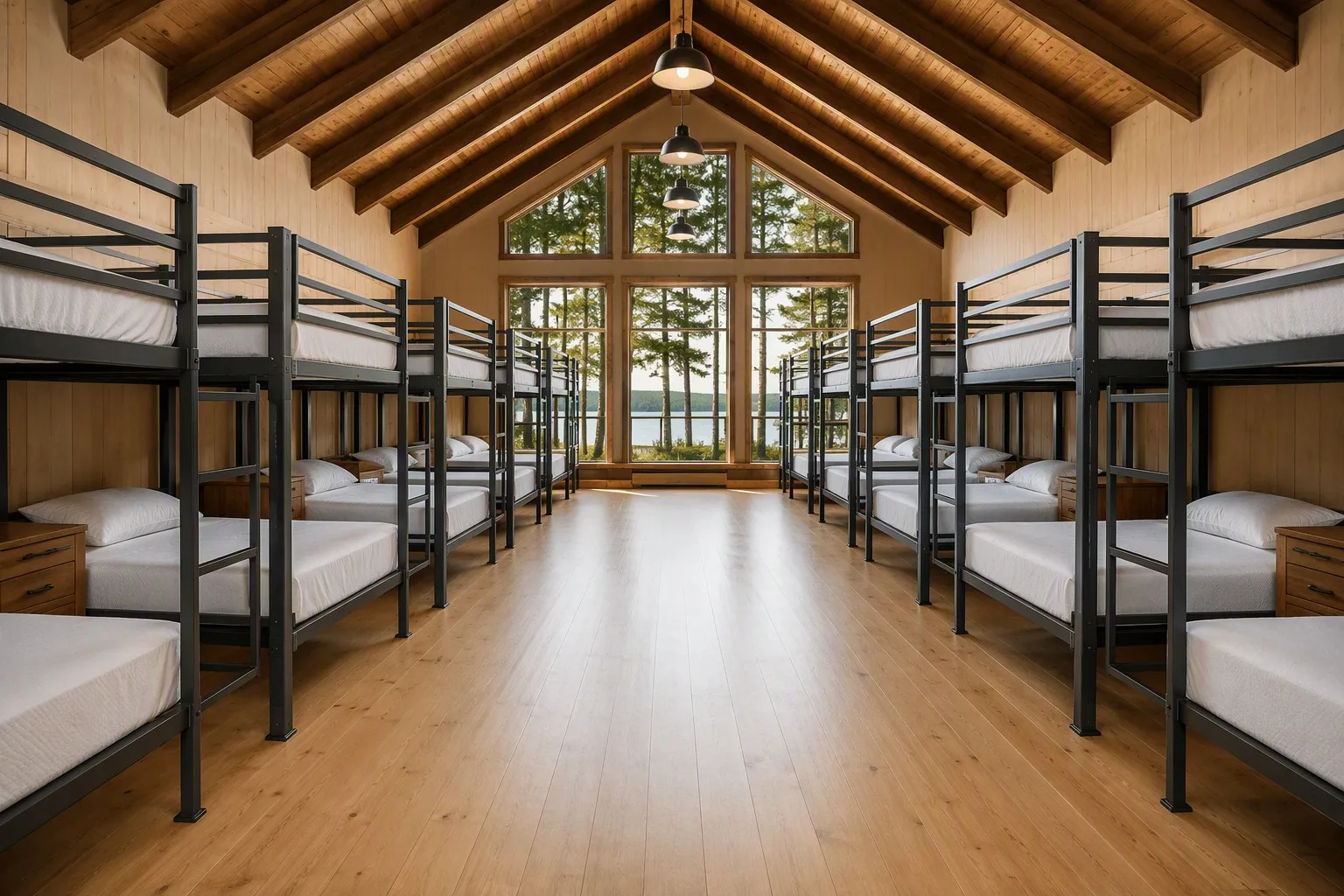
Commercial bunk beds for camps wholesale are infrastructure, not furniture. Buy them like you’d buy boilers or roofing — spec the material, verify the build, test the compliance, and plan for a 10-year service life. The $40-per-unit difference between a properly spec’d commercial bed and a residential bed that’s been “upgraded” with thicker paint will pay for itself the first time you don’t have to replace 30 bunk beds during camp check-in week.
Outfitting a camp, retreat center, or institutional housing facility? We manufacture commercial-grade steel bunk beds with full ASTM F1427 compliance, powder-coated epoxy-polyester finish, and custom configuration options — from twin-over-twin to counselor layouts. [Contact our team] for spec sheets, load-test documentation, and volume pricing.
Frequently Asked Questions
What weight capacity should commercial bunk beds for camps have?
Commercial bunk beds for camp use should support at least 400 lbs per sleeping platform (static load) and 500 lbs for heavy-duty models. This provides a safety margin above the average camper weight and accounts for dynamic loads — kids jumping, leaning on guardrails, and multiple children sitting on one bunk simultaneously. Always confirm the dynamic load rating (impact/drop test) in addition to static capacity.
What safety standards apply to commercial bunk beds in the US?
ASTM F1427-21e1 is the primary safety standard governing bunk beds in the United States. It specifies guardrail height and spacing, mattress retention, structural integrity under load, ladder requirements, and warning labels. Beds with the top of the mattress foundation more than 30 inches from the floor must have guardrails on both sides. The CPSC enforces compliance, and accredited third-party testing documentation should be requested from the supplier.
How many bunk beds fit in a shipping container?
A 40HQ container typically holds 80–120 commercial bunk beds in flat-pack (KD) configuration, depending on bed dimensions and packaging density. This is enough to outfit 40–60 rooms at two beds per room. Flat-pack shipping reduces freight costs by approximately 40% compared to shipping fully assembled units, but requires on-site assembly labor.
What steel thickness should a commercial bunk bed use?
Commercial-grade bunk beds should use 1.5mm minimum wall thickness for main structural members (corner posts, side rails) and 1.2mm minimum for cross-members and slats. Frame members typically use 1.5″ to 2″ steel tubing or angle iron with continuous MIG-welded joints. Residential beds using 1″ thin-wall tube with bolted connections will not survive commercial camp use beyond 2–3 seasons.
What powder coat finish is best for camp bunk beds?
An epoxy-polyester hybrid powder coat applied at 60–80 microns thickness after a zinc phosphate pre-treatment provides the best combination of chemical resistance (for cleaning products and disinfectants), impact resistance, and rust prevention. Single-stage polyester finishes without phosphate pre-treatment will show rust at welds and contact points within 1–2 years in humid or high-use environments.
What is the typical MOQ for wholesale commercial bunk beds?
Factory-direct MOQs for commercial bunk beds typically start at 30–50 units for standard configurations. Fully custom OEM orders with custom colors, guardrail designs, or branding usually require 100+ units. MOQs below 10 units for “commercial grade” typically indicate a reseller or trading company rather than a manufacturer.


