 Skip to content

A glass door storage cabinet does what a solid steel locker never could — it lets you see what’s inside without opening a single door. For offices that need to present files, awards, or inventory with a clean professional look, steel cabinets with tempered glass doors hit the sweet spot between security and visibility.
I got a call last year from a procurement manager at a university in Manila. He’d spent three weeks digging through local furniture catalogs, trying to find storage cabinets that could do two contradictory things at once: keep lab equipment secure and let students and staff see what was inside without touching anything.
His problem wasn’t unique. It’s the exact tension that makes a glass door storage cabinet either the smartest purchase in your facility or a regret you’ll stare at for years.
The difference is almost always in the spec sheet — things most online listings barely mention.
What Actually Makes a Glass Door Storage Cabinet Worth Buying
Here’s the thing nobody tells you upfront: not all glass door cabinets are built for the same job.
Walk through a furniture showroom and you’ll see glass-front cabinets marketed for kitchen displays, living room curios, and retail shelving. They look great in the catalog. Put 30kg of binders on those shelves six months later, and the particleboard starts sagging. Slam a door twice and the hinge alignment shifts by a millimeter you’ll notice every time you walk past.
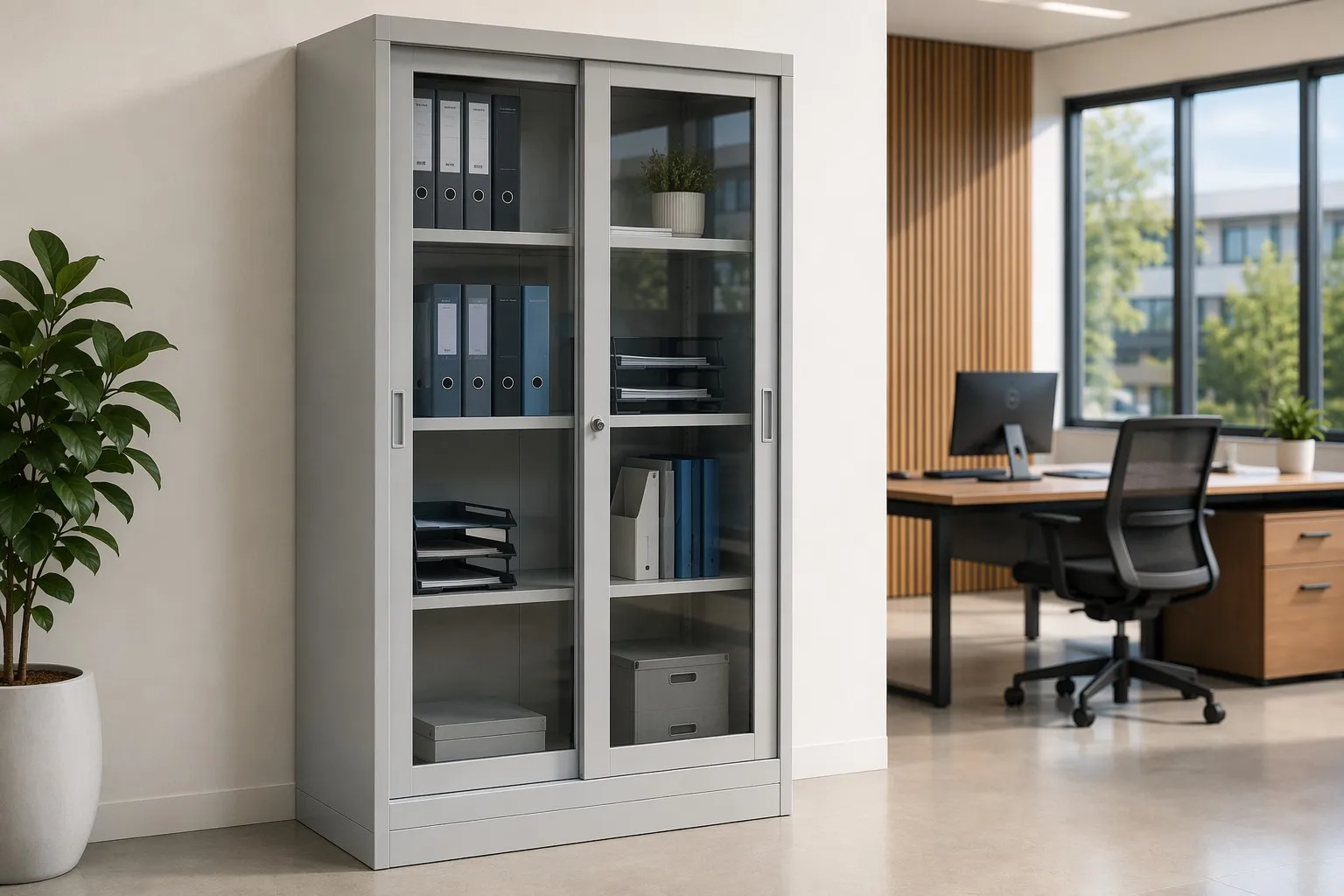
A commercial-grade glass door storage cabinet is a fundamentally different product. The cabinet body is cold-rolled steel — typically 0.6mm to 0.8mm thick — powder-coated for rust resistance. The glass isn’t ordinary window glass; it’s tempered safety glass, usually 4mm or 5mm thick, rated to handle impact that would shatter household glass into dangerous shards.
The shelves lock into place with metal clips or bolts, not plastic pegs. The door hinges are reinforced. And the lock — if it’s worth the money — is a proper cam lock with unique keys, not a flimsy wafer lock you could pick with a paperclip.
These differences are invisible in a product photo. They become very visible about two years in.
Steel vs. Wood: The Decision That Changes Everything
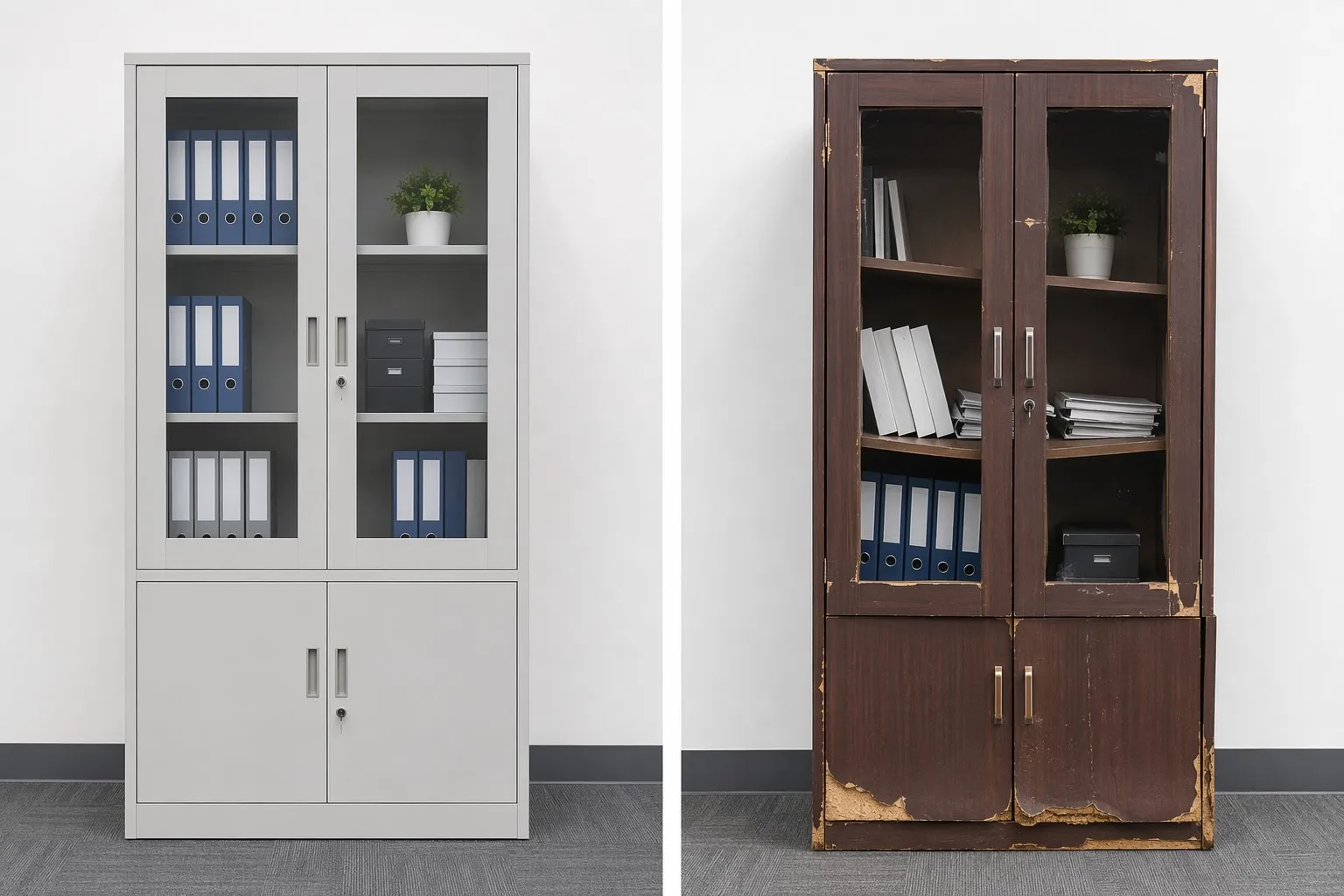
Most glass door cabinets sold online are wood-based — MDF, particleboard, or plywood with a laminate finish. For a home office or a retail display that doesn’t get heavy use, they work fine.
For anywhere that sees daily traffic — an open-plan office, a school admin wing, a hospital supply room, a factory QC station — wood fails in predictable ways. Door edges chip. Moisture swells the panels. Shelf pegs wear out their holes and the whole shelf drops.
Steel doesn’t do any of that.
Cold-rolled steel cabinets with powder-coated finishes handle humidity swings, accidental bumps from rolling chairs, and the slow grind of five people opening the same door forty times a day. The trade-off is weight — a steel glass door storage cabinet is heavier and more expensive upfront. But spread that cost over a 10-year service life versus replacing a particleboard cabinet every 3–4 years, and the math favors steel every time.
One thing worth knowing: when you’re comparing steel cabinets, ask about the steel thickness in millimeters, not “gauge.” Gauge numbers are inversely numbered and vary between materials — a 22-gauge steel panel and a 20-gauge steel panel are different thicknesses, and manufacturers sometimes mix standards. Stick to millimeters. For office storage, 0.6–0.7mm is standard; for industrial applications that hold tools or heavy equipment, 0.8–1.0mm is where you want to be.
Glass Type, Lock Security, and Shelf Load — The Three Specs That Matter
If you’re spec’ing a glass door storage cabinet for a commercial purchase order, here are the three things to nail down before you even look at color options.
Tempered Glass: Not Optional
Regular annealed glass breaks into sharp daggers. Tempered glass breaks into small, relatively harmless pebbles. For any cabinet in a workplace, school, or public area, tempered glass isn’t a premium upgrade — it’s the minimum safety requirement. Check the spec sheet for “tempered” or “toughened” glass, typically 4mm or 5mm thickness. If the listing doesn’t specify, assume it’s not tempered.
Locks That Actually Lock
A cam lock with a unique key code is the baseline for any commercial cabinet. Some manufacturers use wafer locks that share the same key across entire production batches — which means someone three offices down might be able to open your cabinet with their key. For higher security, look for cabinets that support padlock hasps or electronic keypad locks as options.
Shelf Load Rating
This is the spec that separates display cabinets from storage cabinets. A display cabinet shelf might hold 15–20 kg. A proper storage cabinet shelf should hold 40–60 kg minimum. Ask for the per-shelf load rating, not the total cabinet capacity — and confirm whether that rating assumes evenly distributed weight (which is the standard assumption, and not how anyone actually stacks things).

Configurations: How Many Doors, What Height, and Where It Goes
A glass door storage cabinet isn’t one product — it’s a category with configurations that solve different problems.
Single-door cabinets (typically 36–42 inches tall) work as under-window storage or departmental supply units. They’re the workhorse of school offices and clinic reception areas.
Double-door full-height cabinets (66–78 inches) are the standard for central filing, library stacks, and inventory rooms. These usually have 3–5 adjustable shelves and can double as room dividers in open-plan spaces.
Sliding glass door cabinets solve a specific spatial problem: when you can’t afford the clearance arc of a swing door in a narrow corridor or tight workstation cluster. The trade-off is that sliding doors never give you full simultaneous access to both sides of the cabinet.
Combination cabinets — half solid steel door on the bottom, half glass door on top — are quietly one of the most practical configurations. Keep the stuff you don’t want people to see behind the steel door and the stuff you want visible behind the glass. Executive offices and medical supply rooms use these heavily.
| Configuration | Typical Height | Best For |
|---|---|---|
| Single-door | 36–42 inches | Under-counter, departmental |
| Double-door full-height | 66–78 inches | Central storage, filing |
| Sliding door | 66–78 inches | Narrow spaces, corridors |
| Combination (steel + glass) | 66–78 inches | Mixed secure/visible storage |
Where These Cabinets Actually Go to Work
The product photography never shows the real environments. Here’s what actually happens:
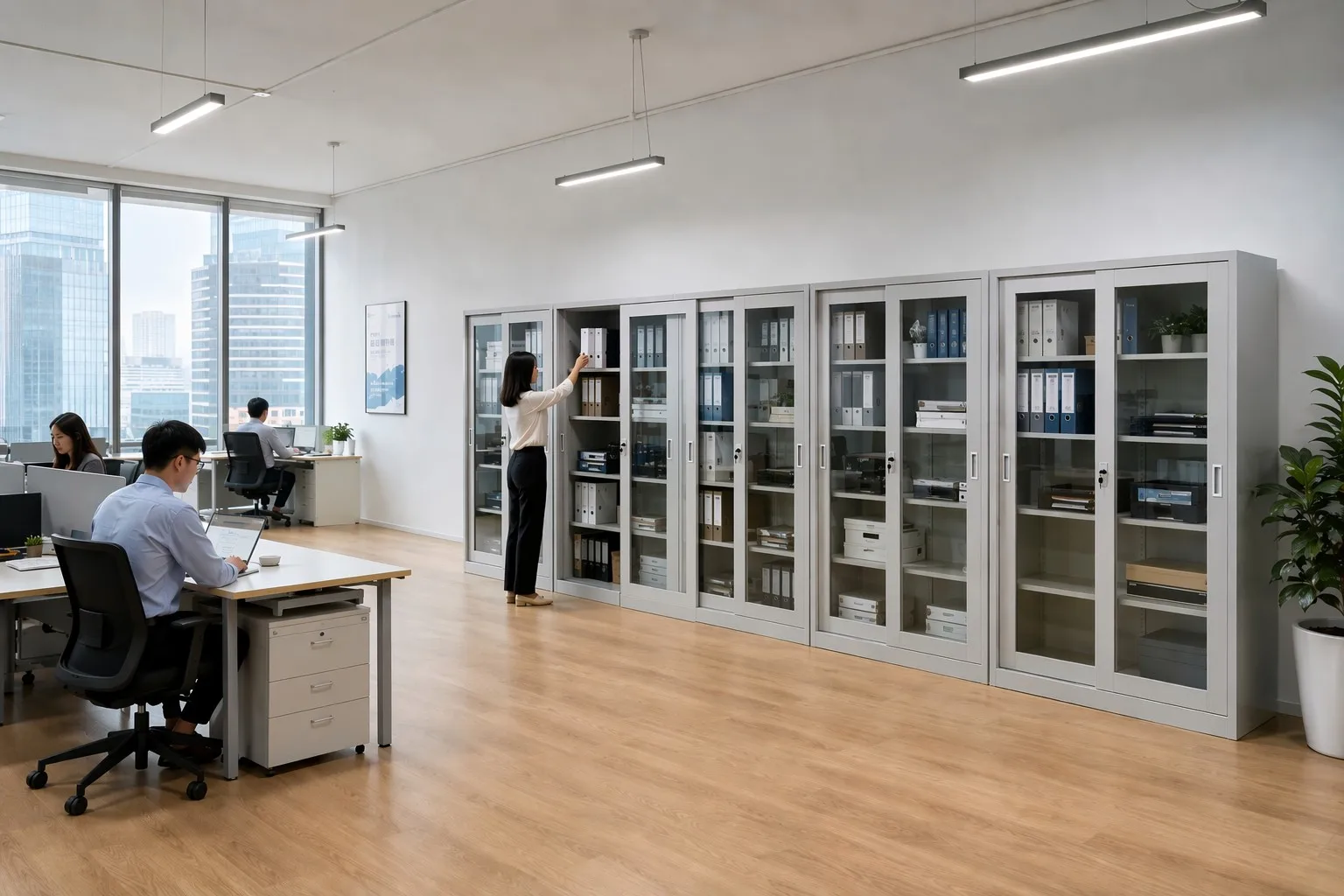
Open-plan offices use glass door cabinets to store reference binders, office supplies, and shared equipment. The glass front means nobody has to open three wrong cabinets to find the toner cartridges. It also forces people to keep the interior organized, because everyone can see it.
School and university administration favors these cabinets for student records, exam materials, and departmental resources. The visibility requirement is often driven by audit protocols — external reviewers need to verify storage conditions without touching anything.
Medical and laboratory settings use glass door cabinets for instrument storage, sample archives, and supply inventory. The key requirement here is cleanability: smooth powder-coated steel surfaces and glass panels can be wiped down with disinfectant, unlike wood laminate that absorbs chemicals and degrades over repeated cleaning.
Showrooms and retail are the most obvious use case — display inventory behind glass while keeping it dust-free and finger-proof. But the cabinets here need to look as good as the merchandise they’re protecting, which puts higher demands on the powder-coat finish quality and the consistency of the glass panel tinting.
Industrial QC stations are the unexpected application. A glass door cabinet on the factory floor holds calibrated instruments, reference samples, and inspection records — protected from dust and workshop debris, but instantly accessible and visible to shift supervisors.
How to Buy Without Getting Burned
After seeing enough purchase orders go sideways, here’s what I’d tell anyone sourcing these cabinets at scale.
Get the spec sheet, not the brochure. Marketing copy says “heavy-duty” and “premium finish.” The spec sheet says 0.6mm cold-rolled steel, epoxy-polyester powder coat, 5mm tempered glass, 50kg per shelf. One of these is useful.
Ask about spare parts. Hinges wear. Keys get lost. Glass panels crack — it’s rare with tempered glass, but it happens. A manufacturer that can’t ship you a replacement door panel and a set of hinges six months after delivery is not a manufacturer you want to depend on.
Check the packaging spec. Steel cabinets that arrive with dents and scuffs aren’t defective — they were under-protected in transit. Edge protectors, foam layers between doors and frame, and a pallet base that can survive a forklift bump are not nice-to-haves. They’re the difference between a cabinet you can install immediately and one you’re arguing with a freight company about.
Confirm the assembly model. Some steel cabinets ship fully welded and assembled. Others are KD (knock-down) — flat-packed with bolts and instructions. KD saves on shipping volume and cost, especially for container orders, but requires competent assembly on site. Know which you’re getting and plan accordingly.
The Bottom Line
A glass door storage cabinet is one of those products where the price tag tells you about a quarter of the story. The steel thickness, the glass rating, the hinge design, the powder-coat durability, and the manufacturer’s willingness to support you after the invoice is paid — that’s the other three-quarters.
If you’re outfitting a single executive office, buy what looks good and fits the space. If you’re procuring 50 units for a new building or replacing cabinets across a school district, spec the steel, verify the glass, test the lock, and buy from someone who treats a purchase order as the beginning of a relationship, not the end of a transaction.
Looking to source commercial-grade glass door storage cabinets directly from a manufacturer? [Contact our team] for spec sheets, volume pricing, and custom configuration options — we manufacture steel storage cabinets with tempered glass doors for office, educational, medical, and industrial applications worldwide.
Frequently Asked Questions
What is a glass door storage cabinet?
A glass door storage cabinet is a steel or wood storage unit fitted with transparent glass panel doors, allowing users to see stored contents without opening the cabinet. Commercial-grade versions use cold-rolled steel bodies (0.6–0.8mm thick), tempered safety glass (4–5mm), and adjustable shelves with load ratings of 40–60 kg per shelf.
Are glass door storage cabinets secure?
Yes — provided they’re spec’d correctly. Commercial glass door storage cabinets use cam locks with unique key codes, not wafer locks. The tempered glass panels are impact-resistant and, unlike household glass, break into harmless pebbles rather than sharp shards. For additional security, look for models that support padlock hasps or electronic keypad upgrades.
What’s better for an office: steel or wood glass door cabinets?
Steel glass door cabinets outperform wood for commercial and office environments. Steel resists moisture, pests, warping, and denting — issues that degrade MDF and particleboard cabinets over 3–5 years of daily use. Steel cabinets carry a higher upfront cost but typically last 10+ years versus the replacement cycle of wood-based cabinets. The one reason to choose wood is aesthetics in low-traffic executive spaces where industrial appearance would feel out of place.
Can glass door cabinets hold heavy items?
Commercial-grade glass door storage cabinets with reinforced steel frames can support 40–60 kg per shelf when weight is evenly distributed. Always confirm the per-shelf load rating from the manufacturer’s spec sheet — “total cabinet capacity” figures assume optimal weight distribution and shouldn’t be relied on alone.
What thickness of glass should a storage cabinet use?
4mm or 5mm tempered glass is the minimum for any glass door storage cabinet in a commercial setting. Tempered glass is 4–5 times stronger than standard annealed glass and shatters into small granular pieces instead of dangerous shards. If the product specification doesn’t explicitly state “tempered” or “toughened” glass, assume it isn’t.
How do I stop glass door cabinets from looking messy inside?
The visibility that makes glass door cabinets useful is also what makes a disorganized cabinet impossible to ignore. Use uniform binder colors, labeled shelf dividers, and matching storage boxes. Some facilities add frosted film to the lower half of the glass — keeps contents visible where it matters and hides clutter below sightline.


