 Meteen naar de inhoud

Snel antwoord: Before signing with a locker manufacturer, verify that the company controls production, can prove realistic capacity, follows a written sample-approval process, documents quality checks, and accepts clear contract terms for delivery, packaging, warranty, and claims. A polished catalogue is useful. Evidence tied to your exact order is what protects the project.
A buyer I spoke with once had two quotations that looked almost identical. Same locker dimensions. Same powder-coated finish. Same promise of factory-direct pricing. One supplier was slightly cheaper, so the choice seemed easy until the buyer asked both companies for a live video call from the production floor.
The first sales representative walked through cutting, punching, bending, coating, and packing areas. The second sent a three-year-old promotional video and avoided every request to show the current workshop. That short call did more than another week of price negotiation.
Het kiezen van een locker manufacturer is less about finding the lowest number on a spreadsheet and more about proving who will control the order after the deposit is paid. The nine checks below focus on commercial due diligence: identity, capacity, sample control, delivery, contracts, and after-sales responsibility. For a separate technical review of steel thickness, hinges, ventilation, and coating, use our OEM metal locker verification guide.
Why Locker Manufacturer Verification Starts Before the Quote
A quotation tells you what a supplier wants to sell. It does not tell you who owns the machines, whether the factory has enough capacity, or whether the sample you approve will become the reference standard for mass production.
This distinction matters because a manufacturer, exporter, and trading company can all provide a professional PDF. There is nothing automatically wrong with using a trading company, especially when it adds local stock or project management. The problem begins when the business model is hidden. If you believe you are negotiating directly with a factory, the legal entity, payment beneficiary, production address, and factory evidence should support that claim.
Start with a simple rule: do not evaluate a locker manufacturer from one document. Cross-check the business licence, quotation, bank beneficiary, certification holder, website, email domain, and production address. The names should form one understandable chain. If they do not, ask the supplier to explain each relationship in writing.
9 Things to Verify Before Signing with a Locker Manufacturer
1. Confirm the legal company and its actual role
Ask for the registered company name in both English and the local language, its business licence, registered address, factory address, and the full beneficiary name for payment. Then ask one direct question: “Does this legal entity manufacture the lockers, or does it purchase them from another factory?”
A different factory and sales entity may be legitimate, but the relationship must be disclosed. Record it in your supplier file and purchase contract. If the quotation, invoice, certificate, and bank account all show unrelated names, pause the process until the locker manufacturer, exporter, and payment beneficiary are clearly connected.
2. Verify the facility with live, order-relevant evidence
Request a live video tour rather than a prepared corporate video. Ask the representative to show the exterior sign, raw steel storage, cutting and punching equipment, bending stations, assembly area, coating line, inspection station, and packing area. During the call, ask to see a current production order or a handwritten note with the date.
The goal is not to judge whether the workshop looks impressive. You are checking whether the claimed locker manufacturer controls the operations that affect your order. Our guide to Hoe stalen lockers worden gemaakt shows the production stages a factory should be able to explain without relying on vague sales language.
3. Test capacity against your delivery schedule
“Large capacity” means very little without a production plan. Give the supplier your expected quantity, configurations, colors, target inspection date, and shipment window. Ask for a written schedule that covers material purchasing, tooling or drawing approval, fabrication, coating, assembly checks, packing, and container loading.
Then ask what other orders are booked during the same period. A credible answer may include constraints. In fact, a locker manufacturer that identifies a coating-line bottleneck or proposes split shipments is often more trustworthy than one that promises any date immediately.
4. Lock the approved sample to the purchase order
The sample is not merely a product preview. It should become the physical and written reference for mass production. Photograph the approved unit from every side and record the dimensions, visible hardware, color reference, lock model, door gaps, ventilation pattern, internal fittings, packaging, and assembly method.
Give the sample a revision number and attach the approved specification sheet to the purchase order. State that substitutions require written approval from the buyer. Without this step, the locker manufacturer may treat the sample as a presentation piece rather than the binding production standard.
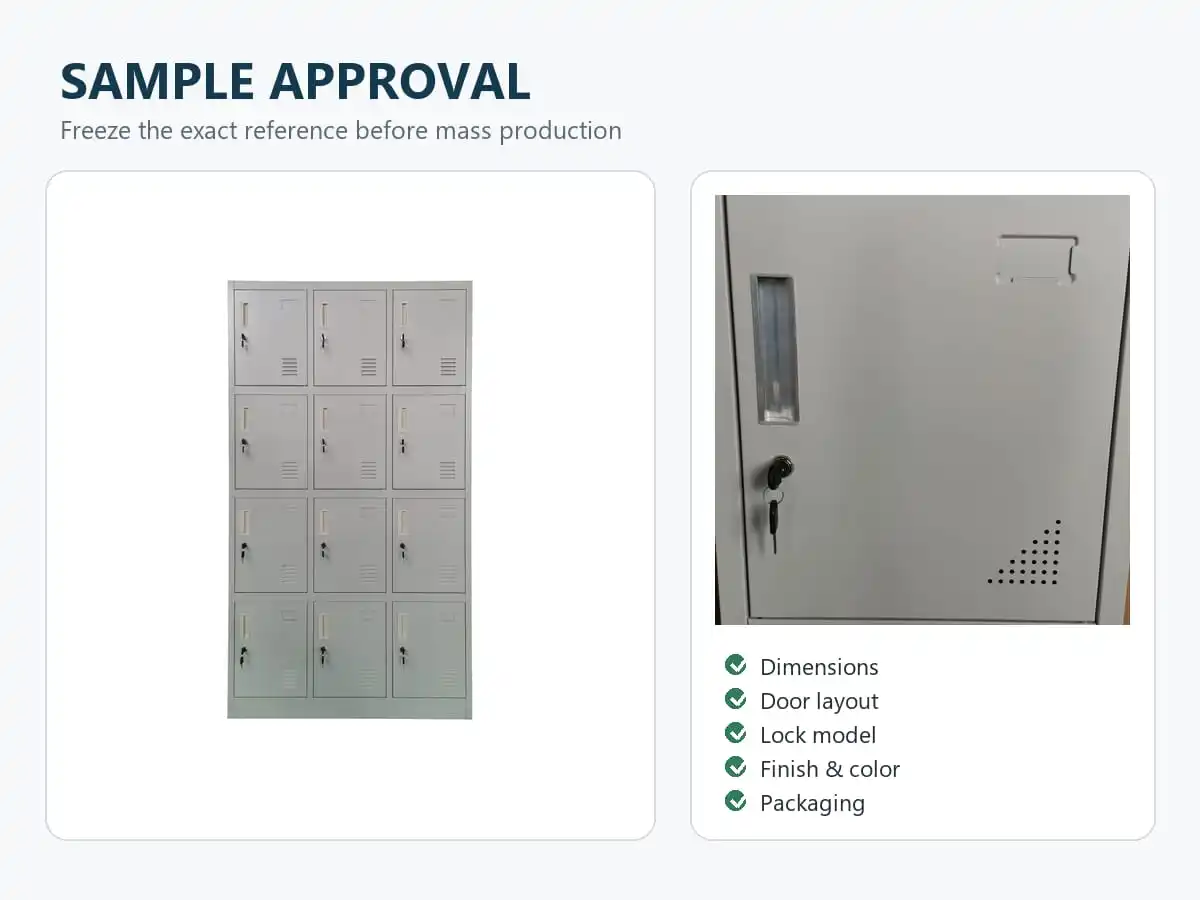
5. Ask for the quality-control records, not just the promise
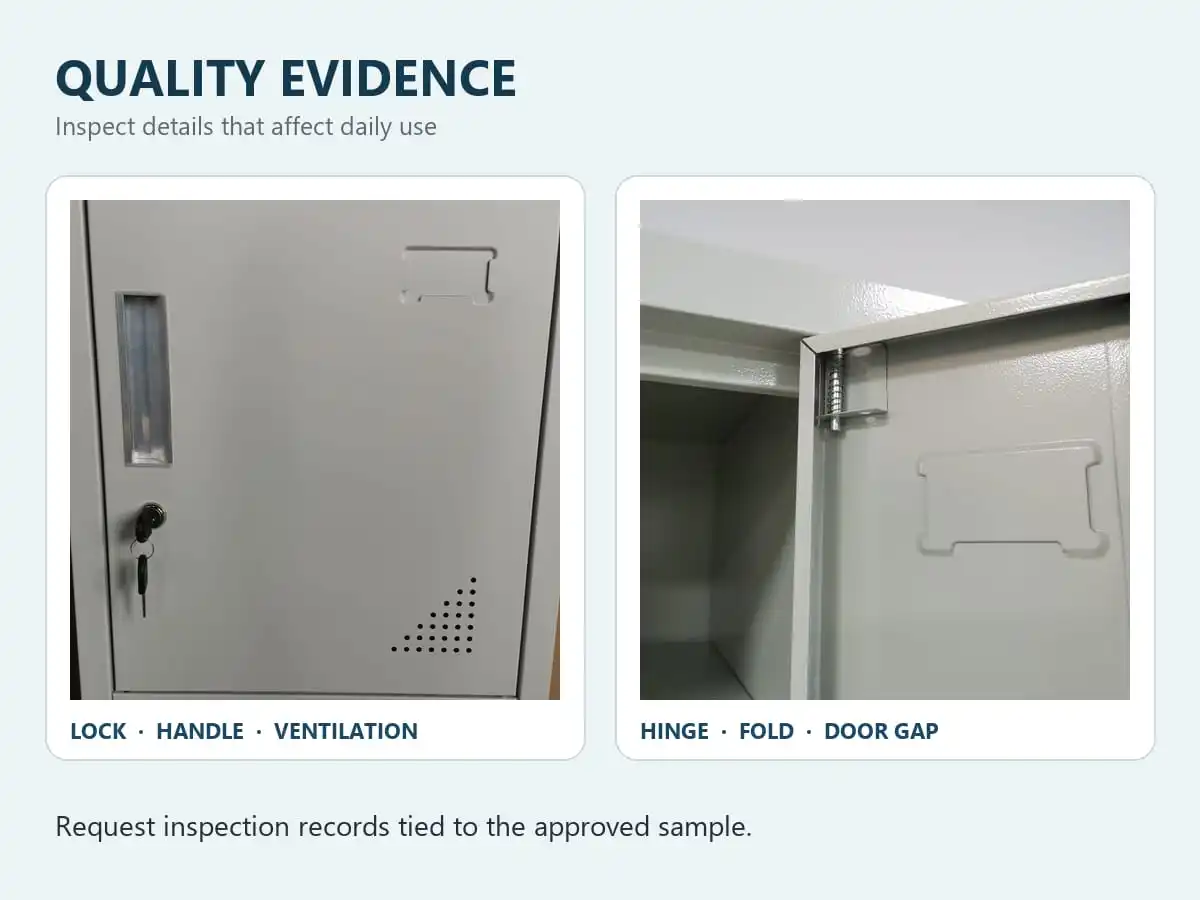
Most suppliers will say they inspect every order. Ask what that sentence means in practice. A useful locker manufacturer inspection plan identifies the checkpoint, acceptable tolerance, inspection frequency, responsible person, and record produced.
For a steel locker order, the file may include incoming material records, first-article confirmation, dimensional checks, coating appearance, door operation, lock function, assembly fit, carton condition, and final quantity. You do not need an elaborate manual. You need a repeatable process that leaves evidence.
For larger or unfamiliar orders, reserve the right to arrange an independent pre-shipment inspection. The inspection standard should be agreed before production, not invented when the goods are already packed.
6. Check engineering control over customization
Custom color is easy to promise. Custom dimensions, door layouts, lock cut-outs, internal partitions, branding, and knock-down joints require controlled drawings and tooling.
Vraag de locker manufacturer to issue a signed drawing or specification sheet showing the approved configuration. Every revision should have a date and version number. If a sales representative accepts a structural change without checking engineering or production, treat that as a warning. The factory may not have evaluated whether the change affects door clearance, strength, packing, or assembly.
7. Review packaging and the container-loading plan
A locker can pass factory inspection and still arrive damaged. Ask for the packed dimensions, gross weight, carton construction, internal protection, hardware bag position, assembly instructions, pallet method if used, and estimated container quantity.
For international projects, compare the complete landed-cost logic rather than the unit price alone. Ask the locker manufacturer to show how knock-down parts are protected and how the assembly system is checked. Our wholesale lockers from China guide covers shipment planning and the documents buyers should request before loading.
8. Put commercial promises into the contract
Important promises should not live only in chat messages. The locker manufacturer contract should identify the legal seller, product revision, quantity, price basis, payment stages, production milestone, inspection right, packing method, shipping documents, and procedure for approved changes.
Define what happens if inspection finds a problem. Will the factory rework the goods before shipment? Who pays for reinspection? What evidence is required for a claim after delivery? Clear terms reduce arguments because both sides know the process before pressure builds.
Do not rely on a broad sentence such as “quality guaranteed.” Name the documents and measurable requirements that govern the order.
9. Verify warranty, spare parts, and claim handling
A warranty is useful only when its scope is clear. Ask which parts are covered, which failures are excluded, how long replacement parts remain available, who pays freight, and how quickly the supplier must respond to a documented claim.
Lock cylinders, keys, hinges, handles, and touch-up materials are inexpensive compared with a service visit. Agree on a spare-parts list before shipment, especially for projects spread across multiple buildings. A dependable locker manufacturer should be able to identify common service parts and match them to the models in your order.
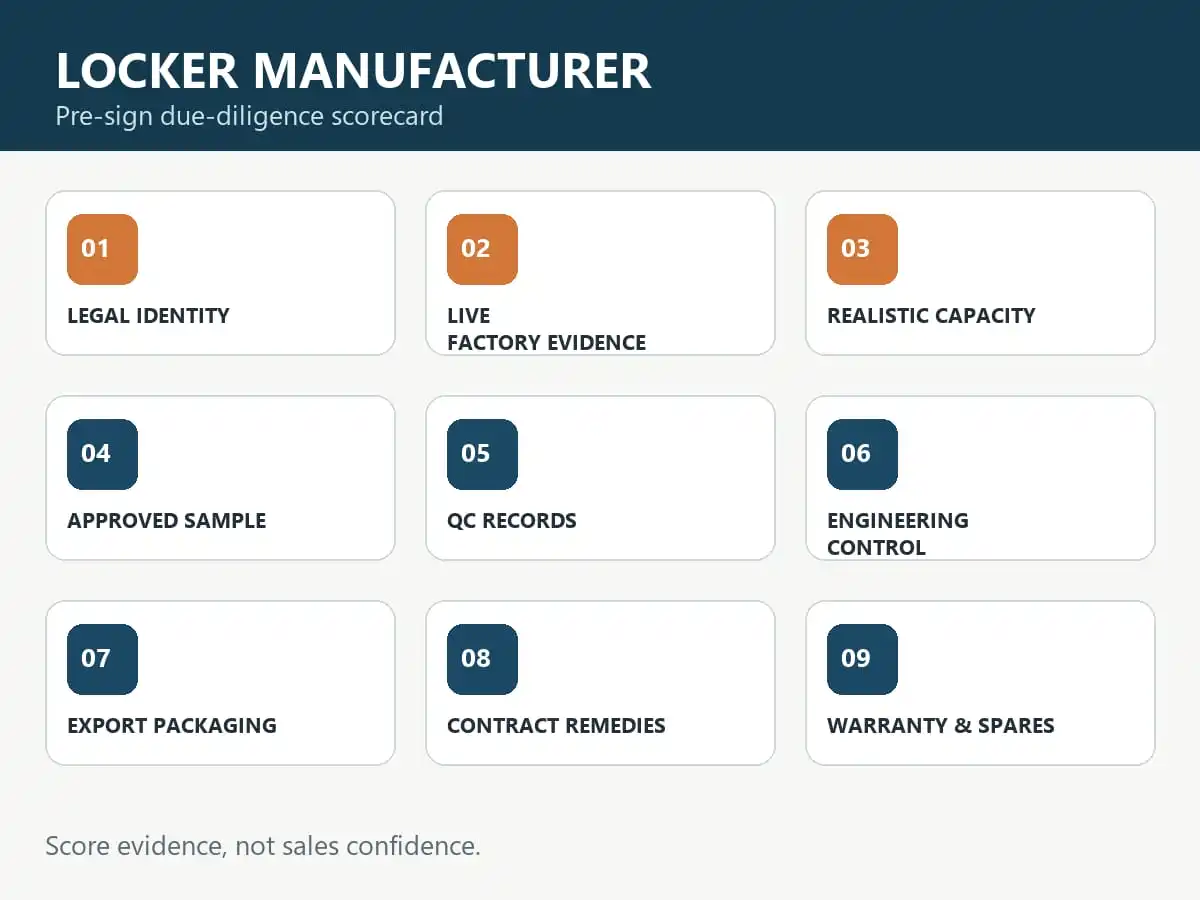
Locker Manufacturer Due-Diligence Scorecard
Use the table below to compare each locker manufacturer using evidence rather than impressions. A supplier does not need perfect marketing. It does need clear answers on the items that affect your money, schedule, and client relationship.
| Verificatiegebied | Bewijsmateriaal om aan te vragen | Warning Sign |
|---|---|---|
| Juridische identiteit | Licence, address, beneficiary, manufacturing relationship | Unexplained company names |
| Fabriekscontrole | Live tour of relevant processes | Only edited promotional footage |
| Hefvermogen | Order-specific production schedule | Any quantity promised immediately |
| Monstercontrole | Approved sample record and revision | No link between sample and PO |
| Kwaliteitscontrole | Checkpoints, tolerances, inspection records | “We guarantee quality” without records |
| Engineering | Version-controlled drawing and specification | Structural changes accepted without review |
| Verpakken | Pack size, weight, protection, loading plan | No export-pack details |
| Contract | Milestones, inspection rights, remedy process | Key promises only in chat |
| Aftersales | Warranty scope, spares, claim workflow | No named responsibility after shipment |
What a Reliable Locker Manufacturer Should Send Before Deposit
Tegen het einde van locker manufacturer due diligence, your project folder should contain a coherent set of documents: company identity, signed quotation, approved drawing, sample record, production schedule, inspection plan, packaging specification, and purchase terms. The documents do not need to be complicated. They need to agree with one another.
For buyers building a shortlist, our independent overview of steel office furniture manufacturers in China explains how different factories fit different procurement needs. If your project also includes cabinets, desks, shelving, or dormitory furniture, review the broader handleiding voor fabrikanten van stalen kantoormeubelen before consolidating categories with one supplier.
How LYBESTEEL Supports Pre-Order Verification
LYBESTEEL manufactures steel lockers and related steel furniture in Luoyang, China. Our documented manufacturing resources include nine CNC production lines, a 400-meter automated electrostatic powder-coating line, raw-material traceability, and finished-product inspection. Our standard MOQ for steel furniture is 100 eenheden.
Before a bulk order, buyers can request an order-specific specification review, sample confirmation, production evidence, inspection coordination, and packing details. This locker manufacturer evidence gives your procurement team material it can check instead of asking it to trust a factory description.
Send us your locker specification
Share the quantity, dimensions, door configuration, lock type, destination, and inspection requirements. We will return a specification review and identify the documents needed before production.
Veelgestelde Vragen / FAQ
How can I verify that a locker manufacturer is a real factory?
Cross-check the legal company name, business licence, payment beneficiary, production address, and certification holder. Then request a live video tour showing the current cutting, punching, bending, coating, inspection, and packing areas. If another company owns the factory, ask for the relationship and authorization in writing.
Should I order a sample before placing a bulk locker order?
Yes. Use the sample to confirm the approved dimensions, hardware, color, lock, ventilation, internal fittings, surface finish, packaging, and assembly method. Give the sample a revision number and attach the approved specification to the purchase order so mass production has a defined reference.
What should a locker manufacturer include in a quotation?
The quotation should identify the exact model or drawing revision, dimensions, materials, configuration, lock, finish, quantity, price basis, packaging, estimated loading quantity, payment terms, production schedule, inspection arrangement, and quotation validity. Vague descriptions make later disputes harder to resolve.
What is a reasonable MOQ for custom steel lockers?
MOQ depends on tooling, color, configuration, and factory scheduling. LYBESTEEL uses a standard MOQ of 100 units for steel furniture, including customized RAL colors. Buyers should confirm whether mixed configurations can be combined within the order and record the approved mix in the purchase documents.
What should a commercial locker warranty cover?
The written warranty should state its duration, covered components, exclusions, claim evidence, replacement method, freight responsibility, and response procedure. Buyers should also agree on spare locks, keys, hinges, handles, and touch-up materials before shipment.
When should I arrange a third-party inspection?
Arrange the inspection terms before production and conduct the final inspection when the order is complete but before shipment. The agreed checklist should cover quantity, dimensions, appearance, operation, packaging, and the approved sample or specification revision.


