 Skip to content

A buyer in the Philippines once asked me: “How do I know your lockers are built to last, not just painted to look nice?” It’s a fair question. The answer isn’t in the brochure — it’s on the factory floor. So here’s exactly what happens between a coil of cold-rolled steel and a finished locker ready to load onto a container.
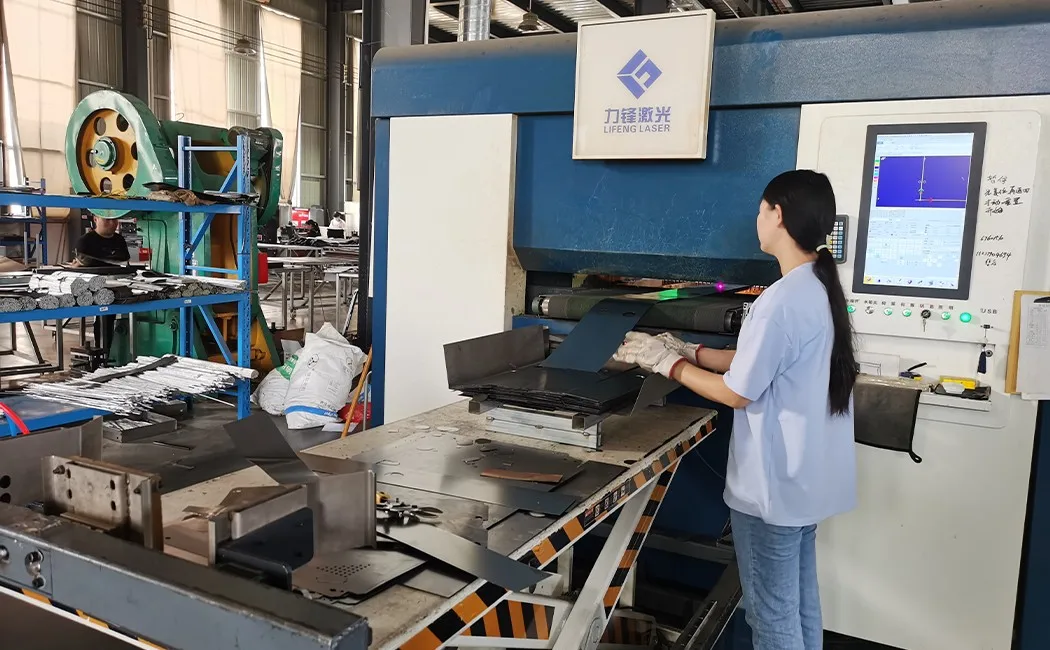
Step 1: Laser Cutting — Where Every Panel Begins
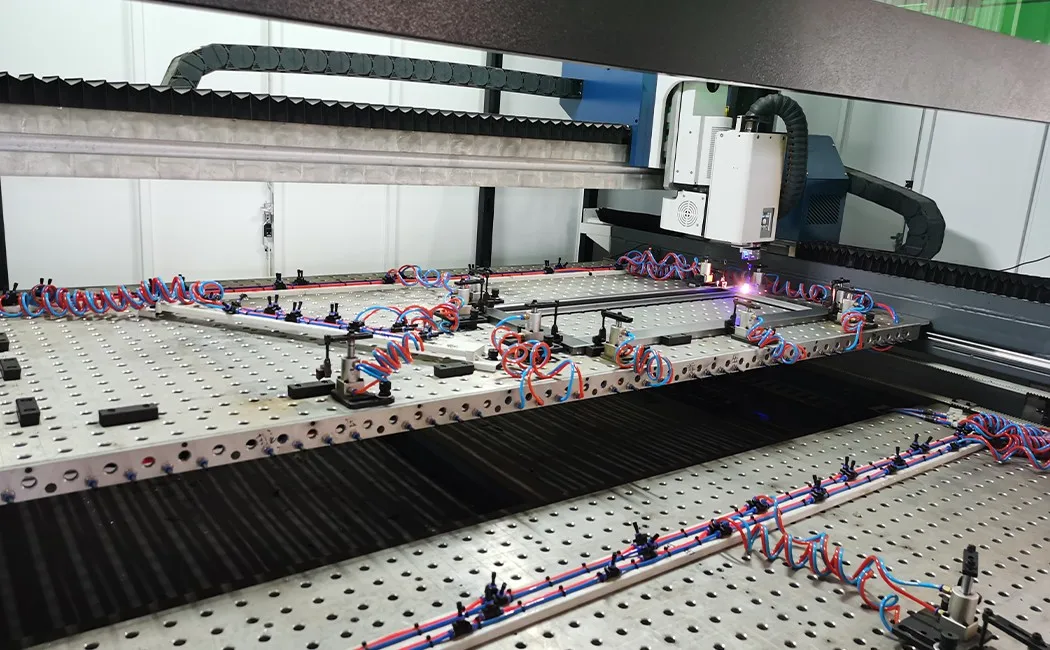
The raw material is cold-rolled steel sheet, typically 0.5–0.8 mm thick for standard office and school lockers, up to 1.0 mm for heavy-duty applications. (Not sure which thickness your project needs? Our steel locker sizes and dimensions guide maps the full 0.4–1.0 mm band to real use cases.) Coils are unrolled onto the laser cutter’s feed table. A fiber laser head — guided by the part program loaded at the operator’s CNC console — traces each panel outline, cutout, and slot at speeds that would be impossible by hand or older plasma methods.
Precision matters here because a panel that’s 0.5 mm out of square won’t close flush at the door. The fiber laser cuts clean edges with minimal heat distortion, so the downstream bending press gets panels that are truly flat and dimensionally consistent — unit 1 and unit 500 are the same.
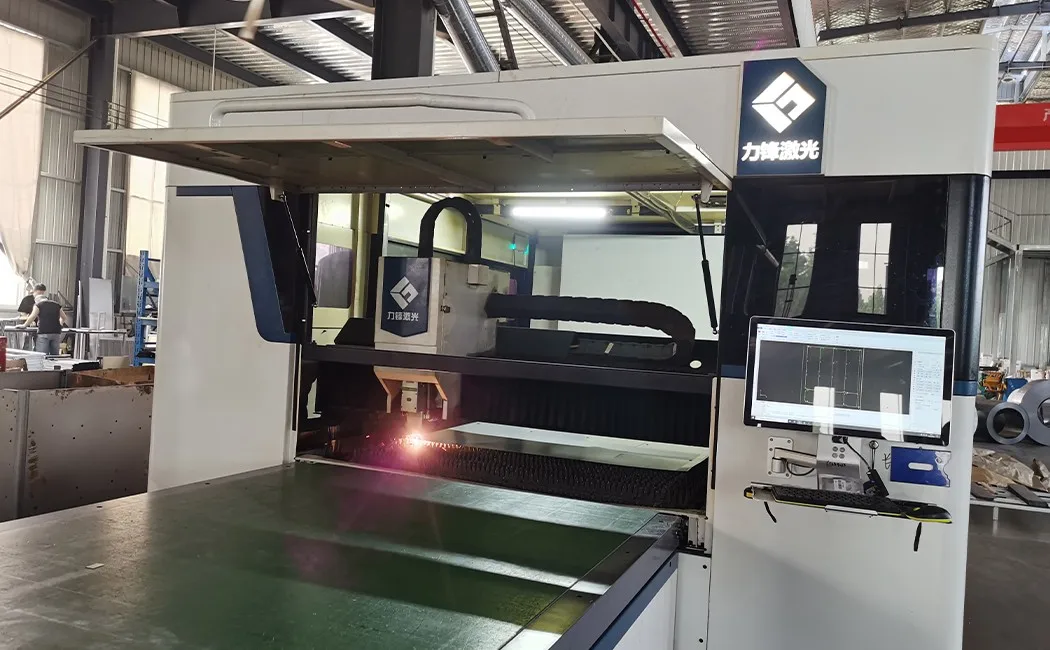
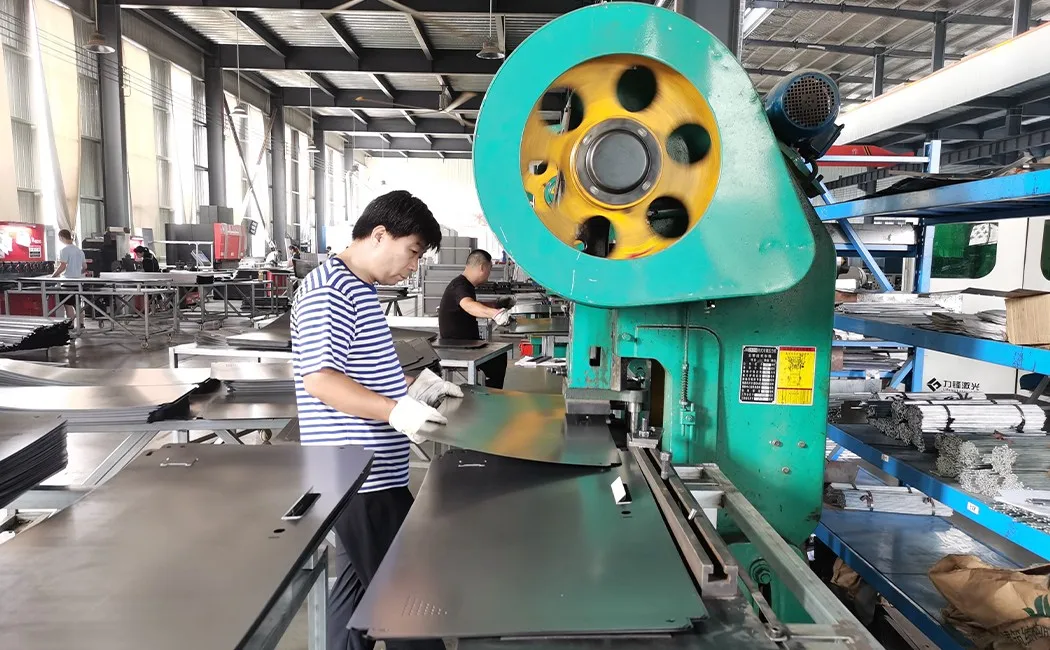
Step 2: CNC Punching — Holes That Aren’t an Afterthought
Freshly cut panels move to the CNC turret punch press. This is where ventilation slots, hinge mounting holes, lock barrel cutouts, and hanging rod brackets are all pressed in a single automated pass. School projects are where punch consistency shows up fastest — our school locker manufacturer guide explains what a proper spec sheet should prove before you order. Older factories drill these by hand — inconsistent positions mean hinges that bind, locks that stick, and shelf pins that sit crooked.
On a CNC punch line, the tool positions are part of the same digital file as the laser cut. Nothing is measured manually. The result is that when you bolt a hinge in position A on the door panel and position A on the carcass panel, they align because both holes were punched from the same coordinates — not because someone got lucky.
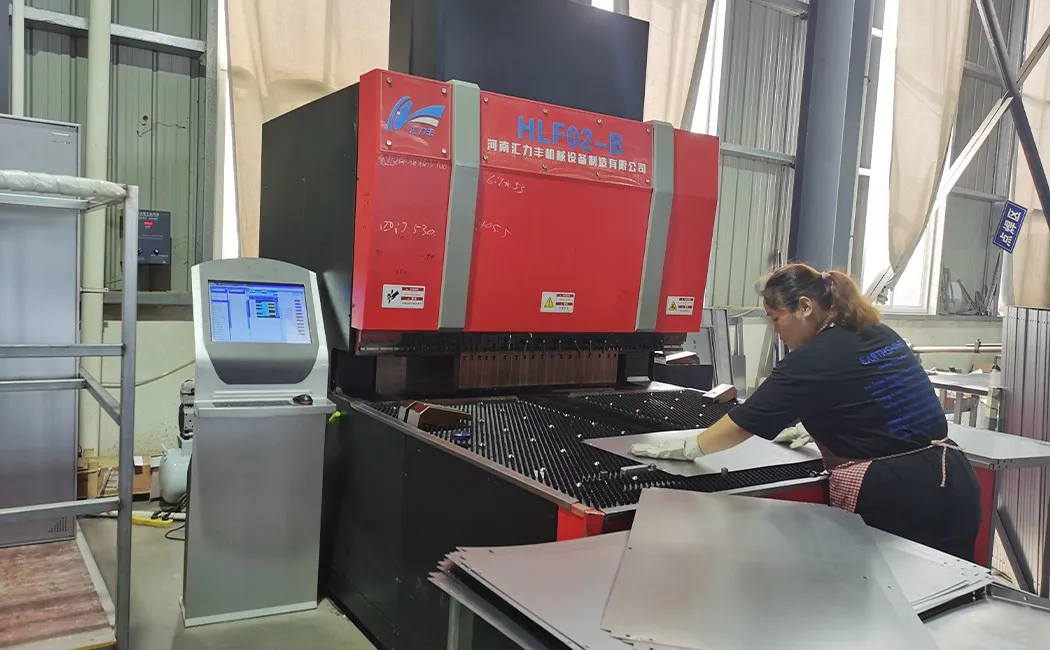
Step 3: Press-Brake Bending — Turning Flat Sheet Into Structure
A flat panel has almost no structural stiffness. Bending changes that. The press-brake folds each panel’s edges into precisely angled flanges — typically 90° returns on side panels, and a compound profile on door panels that forms the door rebate and stiffener in one stroke.
These folds do two things: they create the geometry that locks panels together at assembly, and they dramatically increase the panel’s resistance to flex. A 0.6 mm flat sheet bends easily in your hands; the same sheet with two 90° flanges becomes genuinely rigid. That’s why steel locker gauge (thickness) and fold profile together determine real-world strength — not raw thickness alone.
Step 4: Welding — Permanent Joints Where It Counts
Not every joint in a locker needs to be welded. On KD (knock-down) models, the carcass panels connect at assembly via pre-installed threaded nuts — no welding required by the end user. (If you’re weighing the two structures for your project, our KD vs welded comparison covers strength, shipping cost, and site conditions side by side.) But some structural points — the hinge reinforcement plates, the lock-bar guide brackets, the internal shelf supports on welded-carcass models — are MIG welded at the factory.
MIG (Metal Inert Gas) welding produces a continuous bead that fuses parent metal and filler wire into one piece. Done correctly, the weld zone is at least as strong as the surrounding steel. Our welders work to a seam-length and penetration spec, and welds are visually inspected before panels move to the surface treatment line.
Step 5: Surface Treatment and Powder Coating — The Finish That Protects
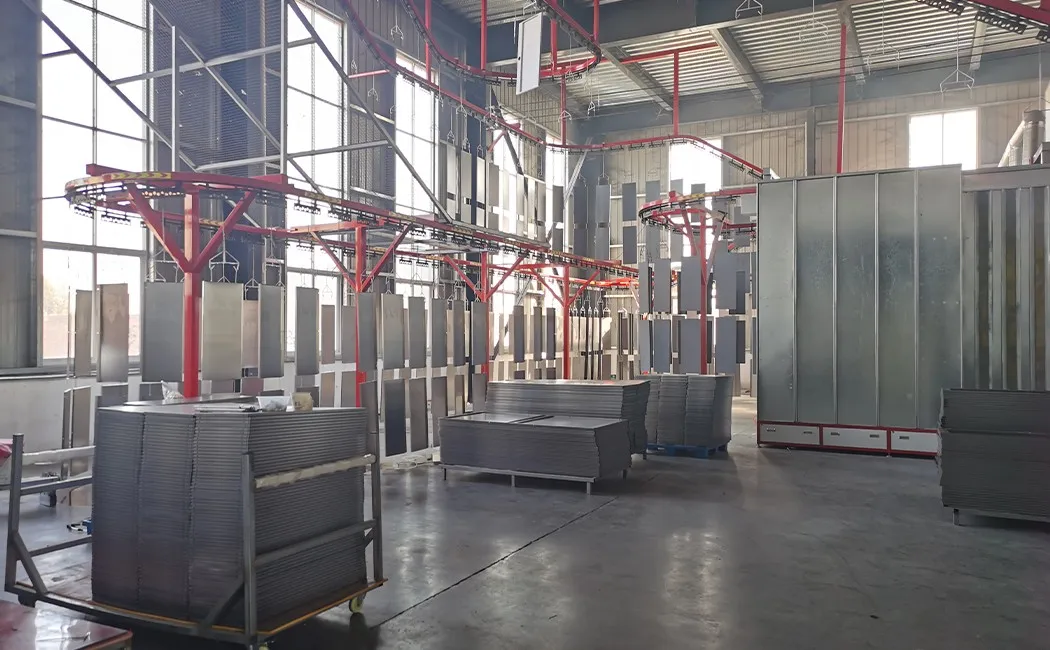
Before powder hits the panel, the steel goes through a multi-stage pre-treatment line: oil removal, rust cleaning, zinc phosphating, and passivation. Skip any of these steps and the powder coat will eventually bubble and peel — not from the outside in, but from the steel surface outward.
After pre-treatment, panels are hung on the overhead conveyor line, moved into the spray booth, and coated electrostatically: the powder is given an electric charge and the grounded panels attract it uniformly — including into recesses and around bends that a paint gun would miss. Then the loaded conveyor carries panels through the curing oven. The heat melts and cross-links the powder particles into a continuous, hard film.
The standard result is a finish that passes 500+ hours of salt-spray testing. Color is a RAL or custom match — light gray, beige, white, or any color the buyer specifies — applied from the same batch to keep the whole order consistent.
Step 6: Flat-Pack Packaging and Container Loading
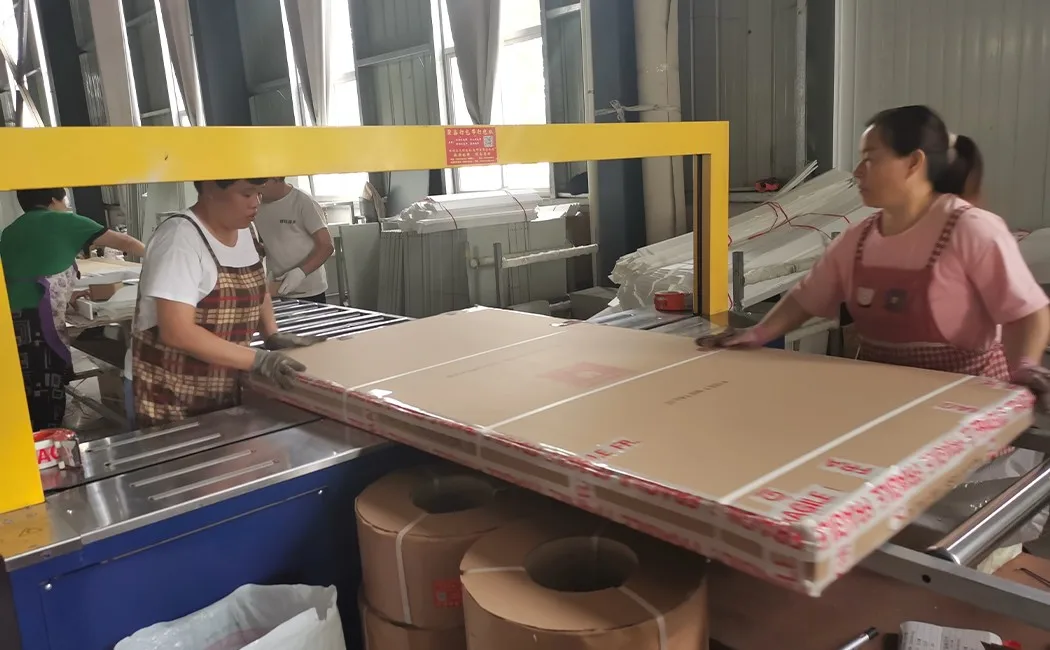
Here’s where KD design pays off for the buyer. Instead of shipping a fully assembled locker — which is mostly air — each unit is broken down into individual panels, wrapped in pearl-cotton protective foam, and packed flat into a carton with all hardware (bolts, nuts, hinges, lock, keys) in a labeled bag inside.
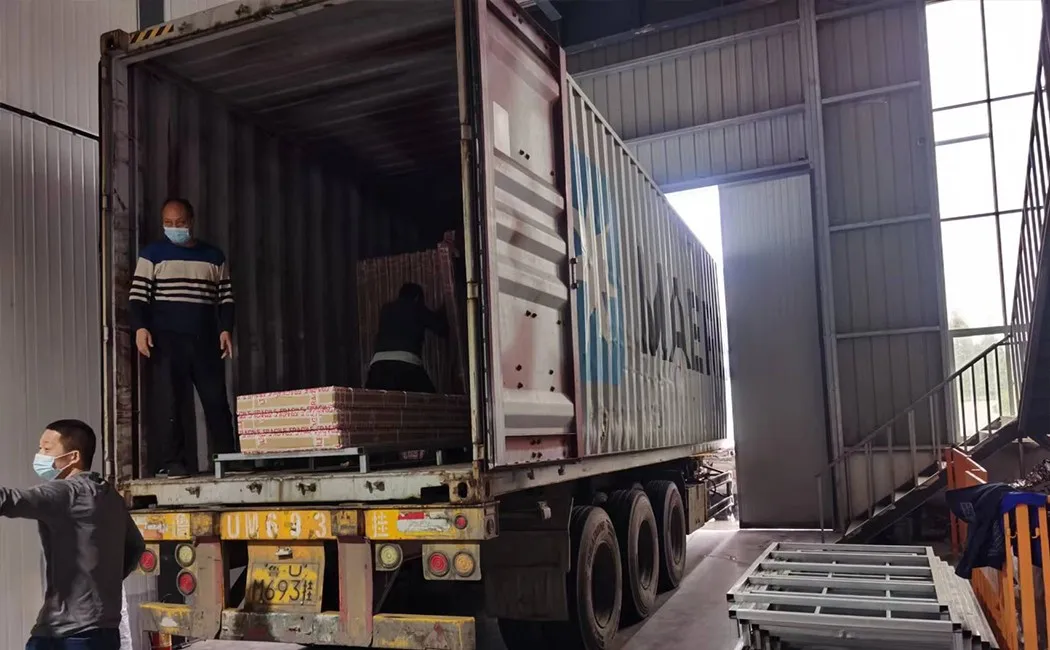
The same freight math applies across our whole KD range — our commercial bunk bed dimensions guide shows how knock-down beds pack flat for identical reasons. Flat cartons stack on pallets or directly on the container floor in tight, stable columns. The loading pattern is planned at the quote stage — it’s part of our job, not an afterthought. The difference versus shipping assembled lockers is significant: flat-pack fits substantially more units per container, which directly reduces the landed cost per piece for the buyer. That saving often exceeds the time cost of on-site assembly, which takes 10–20 minutes per unit with basic hand tools.
The Full Process at a Glance
| Stage | Equipment / Method | Key Quality Check |
|---|---|---|
| 1. Laser Cutting | Fiber laser CNC | Panel dimensions ± 0.1 mm |
| 2. CNC Punching | Turret punch press | Hole position accuracy, burr-free edges |
| 3. Press-Brake Bending | CNC press brake | Bend angle, flange return length |
| 4. Welding | MIG welding | Seam length, penetration, visual inspection |
| 5. Pre-treatment + Powder Coat | 5-stage chemical bath + electrostatic spray + oven cure | Coating thickness (µm), adhesion cross-cut |
| 6. Packing + Loading | Pearl-cotton wrap, carton strapping, container load plan | Hardware completeness, carton weight, label accuracy |
What This Means When You’re Sourcing
The process above is standard among serious steel locker factories — and rare among the rest. Our roundup of the top steel office furniture manufacturers in China shows what separates the two groups in practice. The differences between a good factory and a mediocre one usually come down to three things:
- Steel thickness and grade — ask for the actual mm spec, not “18 gauge” (a number that means different things in different standards). Our standard is 0.5 mm for side panels, 0.6 mm for doors; heavy-duty models use 0.8–1.0 mm.
- Pre-treatment before powder coating — a 5-stage line (oil removal → rust clean → phosphate → passivate → rinse) is the minimum for a finish that holds up. Fewer stages means the coating is sitting on steel that isn’t properly prepared.
- Panel-to-panel consistency — request a sample from mid-run, not just the first piece. CNC lines should produce identical panels across a full order; hand-operated lines drift.
If a supplier can’t tell you their steel thickness in millimeters, the number of pre-treatment stages, or whether their punch press is CNC or manual — those are questions worth pressing on before you place an order.
Frequently Asked Questions
What material is used to make steel lockers?
Most steel lockers are made from cold-rolled steel sheet, typically 0.4–1.0 mm thick depending on the application. Cold-rolled steel offers a smoother surface finish and tighter dimensional tolerances than hot-rolled steel, which is important for clean door alignment and a uniform powder-coat finish.
How long does it take to manufacture a steel locker?
For a standard single-door or multi-door steel locker produced on a CNC production line, the fabrication process from sheet cutting to packed carton typically takes 3–5 working days per batch, depending on order size, powder-coat curing time, and quality inspection stages.
What is powder coating on a steel locker?
Powder coating is an electrostatic dry-finishing process. Fine powder particles are electrostatically charged and sprayed onto the grounded steel panels, then cured in an oven. The result is a hard, even finish that resists chipping, scratching, and rust far better than liquid paint.
Why are steel lockers shipped flat-packed?
Flat-pack (KD — knock-down) shipping collapses each locker into individual panels, which stack tightly in a carton. This significantly increases the number of units per container compared to shipping pre-assembled lockers, reducing freight cost per unit. On-site assembly typically takes 10–20 minutes per unit with basic tools.
What quality checks happen during steel locker production?
Key quality checkpoints include: dimensional inspection of cut and punched panels, weld-seam visual and structural checks, coating thickness and adhesion tests after powder coating, door-alignment and hinge-function checks after assembly, and a final pre-pack inspection before cartons are sealed.


